
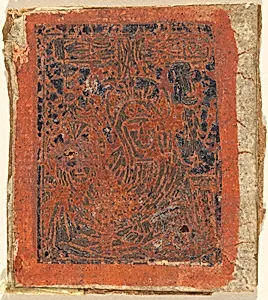
Pietà
c. 1480
Medium
paste print
Dimensions
sheet: 4.7 × 4.1 cm (1 7/8 × 1 5/8 in.)
Classification
Department
CG-E
Museum
National Gallery of Art, Washington, D.C.
Credit
Rosenwald Collection
Accession Number
1943.3.794
Rights
Public Domain
Art Historical Context
This delicate *Pietà*, created by an anonymous German artist around 1480, captures the timeless Christian motif of the Virgin Mary cradling the lifeless body of Christ after his crucifixion. Rendered as a paste print—a rare early printing technique using a paste of whiting and starch pressed through stencils onto paper—it exemplifies the innovative printmaking emerging in late 15th-century Northern Europe. Measuring just 4.7 × 4.1 cm, its miniature scale suggests it was designed for personal devotion, perhaps carried in a prayer book or worn as a talisman by pilgrims. In the context of the Late Gothic period transitioning to the Northern Renaissance, such prints democratized religious imagery, making sacred scenes accessible beyond grand altarpieces. Paste prints like this one were ephemeral yet poignant, often colored by hand for vivid emotional impact. Produced in Germany, a hub of early woodcut and engraving innovation, this work reflects the era's growing emphasis on expressive piety amid the turmoil of the late Middle Ages. Housed in the National Gallery of Art's Rosenwald Collection (Department CG-E), this tiny treasure highlights the artistry of overlooked techniques, inviting visitors to appreciate how even the smallest artifacts carried profound spiritual weight for everyday believers.
About the Artist
German 15th Century · 1400–1500
**German 15th Century** The designation "German 15th Century" encompasses a collective of anonymous artists active in the late medieval and early Renaissance periods in Germany, primarily known through their contributions to early printmaking and panel painting. These creators emerged during a transformative era when woodcuts and engravings began democratizing religious imagery, bridging the Goth...