
Pink-Mouth Murex (phyllonotus erythrostomus)
c. 1646
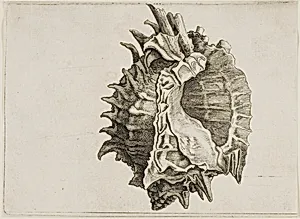
Medium
Etching on ivory laid paper
Dimensions
Sheet, trimmed within platemark at right: 9.7 × 13.3 cm (3 7/8 × 5 1/4 in.)
Classification
etching
Department
Prints and Drawings
Museum
Art Institute of Chicago
Accession Number
145833
Rights
Public Domain
About this artwork
In the 17th century, seashells became popular collectible objects because they were considered rare and exotic. They also became common subjects for still-life paintings known as Vanitas, which symbolically represent the transience of life. The etchings of both Wenceslaus Hollar and Rembrandt van Rijn could represent the simultaneous beauty and fragility of existence. While still lifes in general are exceedingly rare in Rembrandt’s work, Hollar’s etching comes from a series of seashells, consist...
Art Historical Context
Step into the intricate world of 17th-century natural history with Wences Hollar's *Pink-Mouth Murex (Phyllonotus erythrost)*, an exquisite etching created around 1646. This Bohemian-born artist, renowned for his meticulous draftsmanship, captures the delicate spiral of this exotic seashell with astonishing precision. Hollar, who fled the Thirty Years' War and worked in Antwerp and London, produced hundreds of prints, including detailed studies of shells that appealed to Europe's growing fascination with cabinets of curiosities—collections of rare natural specimens prized by scholars and nobility. Etched on ivory laid paper and trimmed to a compact 9.7 × 13.3 cm, the work showcases Hollar's mastery of the etching technique. Using a needle to draw fine lines on a wax-grounded copper plate, he allowed acid to etch intricate textures, from the shell's glossy ridges to its namesake pink interior mouth. This intaglio method enabled multiple impressions, making scientific accuracy accessible beyond the elite. Housed in the Art Institute of Chicago's Prints and Drawings Department, this piece bridges art and science during the early Scientific Revolution. It reflects the era's wonder at the natural world, inviting visitors to marvel at Hollar's ability to render a tropical murex as both a biological marvel and a timeless aesthetic gem.
About the Artist
Wenceslaus Hollar · 1607–1677
Wenceslaus Hollar (1607-1677) was a prolific Bohemian etcher who became one of the most accomplished printmakers of the seventeenth century. Born in Prague, he trained under Matthäus Merian in Frankfurt before entering the service of Thomas Howard, Earl of Arundel, in 1636. Hollar spent most of his career in England, where he produced approximately 2,740 etchings documenting an extraordinary range...