
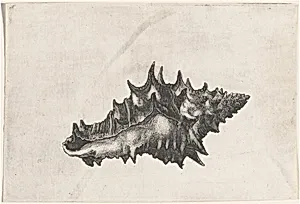
Shell (Vasum ceramicum)
c. 1645
Medium
etching on laid paper
Dimensions
sheet (trimmed to platemark): 9.7 × 14.2 cm (3 13/16 × 5 9/16 in.)
Classification
Department
CG-E
Museum
National Gallery of Art, Washington, D.C.
Credit
Gift of Edward William Carter and Hannah Locke Carter, in Honor of the 50th Anniversary of the National Gallery of Art
Accession Number
1992.17.1
Rights
Public Domain
Art Historical Context
Wenceslaus Hollar's *Shell (Vasum ceramicum)*, created around 1645, captures the intricate beauty of a vase shell—a rare tropical marine specimen prized in 17th-century Europe.lar, a masterful Bohemian etcher who settled in England in 1636, was renowned for his precise depictions of natural history subjects, contributing to the era's burgeoning interest in cabinets of curiosities. These collections of exotic shells, fossils, and artifacts symbolized wealth, scientific curiosity, and the wonders of the natural world amid the Age of Exploration. This small etching on laid paper (9.7 × 14.2 cm) showcases Hollar's virtuosic technique: fine, controlled lines etched into a metal plate with acid, then inked and printed to reveal the shell's textured ridges, glossy curves, and subtle shadows. Etching allowed for unprecedented detail in printmaking, making such scientific illustrations accessible beyond original objects. Produced during the English Civil War, it reflects Hollar's versatility, blending artistry with emerging empirical observation. Today, housed in the National Gallery of Art as a gift honoring its 50th anniversary, this print invites visitors to marvel at how a humble shell bridged art, science, and colonial trade, embodying the intellectual fervor of the Baroque period.
About the Artist
Wenceslaus Hollar · 1607–1677
Wenceslaus Hollar (1607-1677) was a prolific Bohemian etcher who became one of the most accomplished printmakers of the seventeenth century. Born in Prague, he trained under Matthäus Merian in Frankfurt before entering the service of Thomas Howard, Earl of Arundel, in 1636. Hollar spent most of his career in England, where he produced approximately 2,740 etchings documenting an extraordinary range...