
Shell (Murex brandaris)
c. 1645
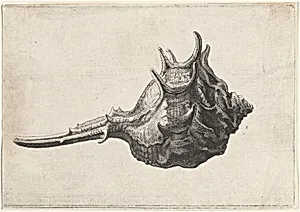
Medium
etching on laid paper
Dimensions
sheet (trimmed to platemark): 9.5 × 13.6 cm (3 3/4 × 5 3/8 in.)
Classification
Department
CG-E
Museum
National Gallery of Art, Washington, D.C.
Credit
Gift of Edward William Carter and Hannah Locke Carter, in Honor of the 50th Anniversary of the National Gallery of Art
Accession Number
1992.17.2
Rights
Public Domain
Art Historical Context
Wenceslaus Hollar *Shell (Murexaris)*, etched around 1645, captures the intricate form of this spiny sea snail with exquisite precision. A Bohemian artist who flourished in England and Antwerp, Hollar was a master printmaker whose works bridged art and emerging scientific curiosity. During the English Civil War, when he briefly resided in Antwerp, he produced detailed natural history studies like this one, reflecting the era's fascination with the natural world in princely cabinets of curiosities, or *wunderkammern*. Rendered in etching on laid paper—a technique Hollar perfected for its fine, fluid lines—the small sheet (9.5 × 13.6 cm) showcases his virtuosic ability to convey texture and light through subtle tonal gradations. Etching allowed for affordable dissemination of such naturalistic images, influencing collectors and scholars alike. The *Murex brandaris*, famously the source of ancient Tyrian purple dye prized by emperors, adds layers of historical allure, linking Hollar's modern gaze to antiquity. Today, this gem graces the National Gallery of Art, a gift honoring its 50th anniversary. It invites visitors to marvel at 17th-century artistry's blend of beauty and observation, a window into a time when art illuminated nature's wonders.
About the Artist
Wenceslaus Hollar · 1607–1677
Wenceslaus Hollar (1607-1677) was a prolific Bohemian etcher who became one of the most accomplished printmakers of the seventeenth century. Born in Prague, he trained under Matthäus Merian in Frankfurt before entering the service of Thomas Howard, Earl of Arundel, in 1636. Hollar spent most of his career in England, where he produced approximately 2,740 etchings documenting an extraordinary range...