
Shell: Hebrew Volute ( Voluta ebraea L)
ca. 1646
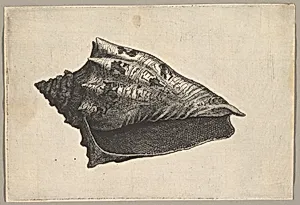
Medium
Etching; only state
Dimensions
Plate: 3 13/16 × 5 9/16 in. (9.7 × 14.2 cm) cut on the platemark at right and with thread mar gins elsewhere
Classification
Prints
Department
Drawings and Prints
Museum
Metropolitan Museum of Art, New York, NY
Credit
The Elisha Whittelsey Collection, The Elisha Whittelsey Fund, 1991
Accession Number
1991.1301
Rights
Public Domain
Tags
Art Historical Context
In the mid-17th century,ian etcher Wenceslaus Hollar captured the intricate beauty of the natural world in his exquisite print *Shell: Hebrew Volute (Voluta ebraea L)*, created around 1646. This etching depicts the elegant spiral shell of a tropical marine mollusk, prized by collectors for its fluted form that evoked ancient Hebrew script—hence its evocative name. Hollar, renowned for his meticulous topographical views and natural history studies, produced a series of such shell prints during his time in Antwerp, reflecting Europe's growing fascination with exotic specimens amid the Scientific Revolution. Etched in a single state on a modest plate measuring just under 4 by 5 ½ inches, the work showcases Hollar's mastery of the etching technique. Using acid to bite fine lines into a metal plate, he rendered the shell's glossy textures, subtle ridges, and luminous highlights with astonishing precision, making it appear almost three-dimensional. This print, now in the Metropolitan Museum of Art's Elisha Whittelsey Collection, exemplifies the era's "cabinets of curiosities," where shells symbolized wonder and divine design. Hollar's shell etchings bridged art and science, influencing later naturalists and artists. Visitors, imagine holding this delicate treasure— a window into 17th-century curiosity and craftsmanship!
About the Artist
Wenceslaus Hollar · 1607–1677
Wenceslaus Hollar (1607-1677) was a prolific Bohemian etcher who became one of the most accomplished printmakers of the seventeenth century. Born in Prague, he trained under Matthäus Merian in Frankfurt before entering the service of Thomas Howard, Earl of Arundel, in 1636. Hollar spent most of his career in England, where he produced approximately 2,740 etchings documenting an extraordinary range...