
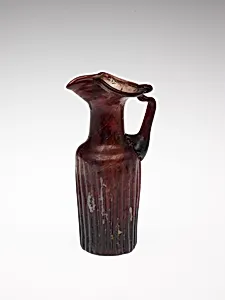
Pitcher
5th-6th century
Medium
Glass, mold-blown technique
Dimensions
13.7 × 6.6 × 4.9 cm (5 3/8 × 2 5/8 × 1 7/8 in.)
Classification
pitcher (vessel)
Department
Arts of Greece, Rome, and Byzantium
Museum
Art Institute of Chicago
Accession Number
132101
Rights
Public Domain
About this artwork
Byzantine glassmakers refined the techniques they inherited from their Roman predecessors, creating objects with increasingly elaborate forms and complex decorative elements to flaunt their skills. Cosmetic containers were often adorned with fine strands (trails) of glass that required a steady hand and rapid execution, while other vessels look quite complex yet were easily made. Glass continued to be used in objects of personal adornment such as jewelry, both as a material in its own right and ...
Art Historical Context
This elegant glass pitcher, crafted in the Byzantine Empire during the 5th or 6th century, reflects the enduring legacy of Roman glassmaking traditions adapted within a Christian cultural context. Standing just over five inches tall, the vessel was likely used for serving liquids in domestic or ceremonial settings, embodying the blend of practicality and refined aesthetics that characterized Byzantine daily life. The pitcher was created using the mold-blown technique, a method in which molten glass was inflated into a carved mold. This innovative approach allowed artisans to produce consistent shapes and subtle decorative patterns efficiently, making glassware more accessible beyond elite circles while maintaining artistic quality. Such vessels highlight the technical sophistication of Byzantine workshops, where glass remained a prized medium for both utility and subtle ornamentation. As part of the Art Institute of Chicago’s collection of Greek, Roman, and Byzantine art, this piece offers a glimpse into the empire’s vibrant trade networks and artistic continuity across centuries. Its modest scale and durable material underscore how everyday objects could carry both functional purpose and cultural resonance in the medieval Mediterranean world.
About the Artist
Byzantine
"Byzantine" is the collective attribution given to anonymous artists working within the Eastern Roman (Byzantine) Empire, whose creations spanned from the 4th to the 15th centuries, primarily in Constantinople and its cultural sphere. These masters produced a vast body of art that defined an era, with museums like the Walters Art Museum and the Art Institute of Chicago cataloging numerous works un...