
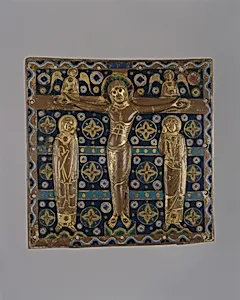
Plaque with the Crucifixion
Unknown Artist
first quarter 13th century
Medium
Copper (plaque): chased, engraved, stippled, and gilt; Champlevé enamel, Figures are applied and gilt; background: turquoise bands with reserved circles and colored rosettes on dark blue ground; colors: red, green, yellow. blue, gray-blue, white.
Dimensions
Overall: 6 5/8 x 6 3/4 x 5/8 in. (16.8 x 17.1 x 1.6 cm)
Classification
Enamels-Champlevé
Culture
French
Department
Medieval Art
Museum
Metropolitan Museum of Art, New York, NY
Credit
Gift of J. Pierpont Morgan, 1917
Accession Number
17.190.781
Rights
Public Domain
Tags
Art Historical Context
This exquisite *Plaque with the Crucifixion*, by an unknown French artist in the quarter of the 13 century, captures a pivotal moment in Christian iconography: Christ on the cross, flanked by sorrowful Virgin Mary and mourning angels. Measuring just over 6 inches square, this intimate devotional object from the Metropolitan Museum of Art's Medieval Art collection viewers into the emotional intensity of the Crucifixion, a central theme in medieval religious art symbolizing sacrifice and redemption. Crafted in copper, the plaque showcases masterful champlevé enamel techniques—troughs carved into the metal are filled with vibrant colors like red, green, yellow, blue, gray-blue, and white, then fired to create a durable, luminous surface. The figures are chased, engraved, stippled, and gilded for a three-dimensional effect, while the background features turquoise bands with reserved circles and colored rosettes on a dark blue ground, evoking heavenly splendor. Champlevé enamel, a hallmark of 12th- and 13th-century French workshops (notably Limoges), was prized for portable altarpieces, reliquaries, and personal piety objects. A gift from J. Pierpont Morgan in 1917, this plaque reflects the era's blend of technical innovation and spiritual devotion, offering a window into how medieval believers carried sacred imagery close to their hearts.