
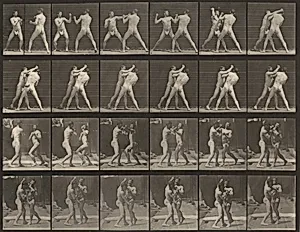
Plate Number 330. Boxing, cross-counter
Medium
collotype
Dimensions
image: 24.6 × 31.6 cm (9 11/16 × 12 7/16 in.) sheet: 47.9 × 60.35 cm (18 7/8 × 23 3/4 in.)
Classification
Photograph
Department
CPH
Museum
National Gallery of Art, Washington, D.C.
Credit
Corcoran Collection (Museum Purchase, 1887)
Accession Number
2014.79.355
Rights
Public Domain
Art Historical Context
Step into the groundbreaking world of motion captured in stillness with *Plate Number 330. Boxing, cross-counter* by Eadweard Muybridge, created in 1887. This collotype print, part of his monumental *Animal Locomotion* series, freezes two boxers mid-action as they deliver simultaneous cross-counter punches—one a left hook to the head, the other a right to the body. Measuring nearly 25 x 32 cm in its image area, it's a precise slice from a larger sheet, showcasing Muybridge's revolutionary sequential photography. Muybridge, a British-born innovator in America, used multiple cameras triggered in rapid succession to dissect human and animal movement, debunking artistic myths about anatomy in motion. This plate exemplifies his chronophotographic technique, where overlapping exposures on a single plate reveal the fluid dynamics of combat sports, blending science and art. Collotype, a photomechanical process, allowed faithful reproduction of these high-detail images, making complex studies accessible. Acquired by the Corcoran Gallery in 1887 and now in the National Gallery of Art's Corcoran Collection, this work holds immense historical significance. It paved the way for cinema—Thomas Edison credited Muybridge's sequences as inspiration—and influenced modern sports photography, offering visitors a thrilling glimpse into the birth of moving pictures through the lens of Victorian-era pugilism.
About the Artist
Eadweard Muybridge · 1830–1904
Eadweard Muybridge (1830-1904) was an English-American photographer who revolutionized the understanding of motion through his pioneering chronophotographic studies. Born Edward James Muggeridge in Kingston upon Thames, England, he emigrated to America and became famous first for his dramatic landscape photographs of Yosemite Valley, then for his groundbreaking motion studies that proved horses li...