
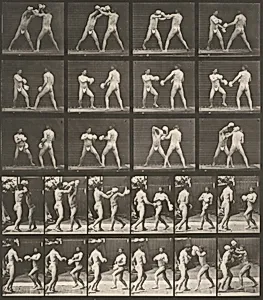
Plate Number 334. Boxing with gloves
Medium
collotype
Dimensions
image: 29.4 × 25.65 cm (11 9/16 × 10 1/8 in.) sheet: 47.8 × 60.4 cm (18 13/16 × 23 3/4 in.)
Classification
Photograph
Department
CPH
Museum
National Gallery of Art, Washington, D.C.
Credit
Corcoran Collection (Museum Purchase, 1887)
Accession Number
2014.79.359
Rights
Public Domain
Art Historical Context
Step into the dynamic world of motion captured in time with *Plate Number 334. with Gloves* by pioneering photographer Eadweardbridge, created in 1887. This collotype print, part of his monumental *Animal Locomotion*, freezes a sequence of two boxers in gloves mid-action, revealing the raw athleticism and rhythm of the sport. Muybridge, a British-American innovator, used banks of up to 24 cameras triggered by the subject's movement to dissect human and animal locomotion, shattering Victorian-era myths about how bodies truly move. The collotype medium—a photomechanical process invented in the 1850s—allowed for exquisite, high-fidelity reproductions of Muybridge's original negatives, making his scientific imagery accessible to scholars, artists, and the public. Measuring 29.4 × 25.65 cm in its image area on a larger 47.8 × 60.4 cm sheet, this plate exemplifies precision engineering in photography, bridging art and science. Muybridge's work, acquired by the Corcoran Gallery in 1887 and now in the National Gallery of Art's collection, profoundly influenced early cinema pioneers like the Lumière brothers and modern stop-motion animation. Gaze upon it and feel the punch of innovation—proof that a single "still" life can pulse with life's energy!
About the Artist
Eadweard Muybridge · 1830–1904
Eadweard Muybridge (1830-1904) was an English-American photographer who revolutionized the understanding of motion through his pioneering chronophotographic studies. Born Edward James Muggeridge in Kingston upon Thames, England, he emigrated to America and became famous first for his dramatic landscape photographs of Yosemite Valley, then for his groundbreaking motion studies that proved horses li...