
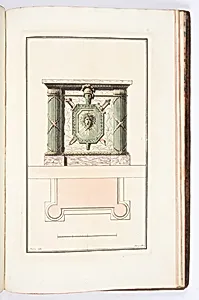
POELE militaire, orné de trophées et faisceaux d’armes en colonnes aux quatre angles
Classification
Department
Smithsonian Collection
Museum
Smithsonian American Art Museum
Credit
Purchased for the Museum by the Advisory Council
Accession Number
1921-6-407-28
Rights
Public Domain
About this artwork
Research in Progress
Art Historical Context
Louis-Gustave Tar (1738–1794), a French engraver and, created *POELE militaire, orn de trophÉes etceaux d’armes en colonnes aux quatre* around 1791. This print depicts a military stove adorned with trophies and bundles of arms forming columns at its four corners, blending functional design with martial symbolism. As a print in the Smithsonian American Art Museum's collection—purchased by the Advisory Council—it reflects the era's innovative use of engraving to showcase decorative arts. Produced amid the French Revolution, the artwork captures the turbulent spirit of the time, when revolutionary fervor elevated military motifs in everyday objects. Stoves like this would have served both practical heating needs and as patriotic statements, with "trophées" (trophies of war) and "faisceaux d’armes" (fasces or weapon bundles) evoking Roman republican ideals repurposed for modern nationalism. Though research is ongoing, this piece highlights prints' role in 18th-century design dissemination, allowing architects and craftsmen to replicate elaborate ornamentation. Taraval's work bridges art and utility, offering visitors a glimpse into how Revolution-era aesthetics militarized domestic life.