
Portable Compass Sundial
c. 1790
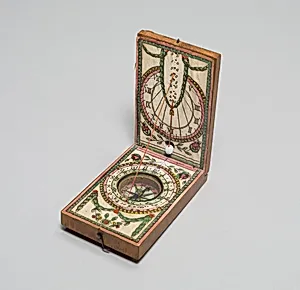
Medium
Wood, hand-colored etching on paper, and glass with string gnomon
Dimensions
8.7 × 5.2 cm (3 7/16 × 2 1/16 in.)
Classification
tool
Department
Applied Arts of Europe
Museum
Art Institute of Chicago
Accession Number
8343
Rights
Public Domain
Art Historical Context
This exquisite Portable Compass Sundial, crafted around 1790, exemplifies the ingenuity of European applied arts during the Enlightenment. Measuring just 8.7 × 5.2 cm, this pocket-sized tool allowed travelers and scholars to tell time using the sun's shadow, blending scientific precision with elegant design. Housed in the Art Institute of Chicago's Department of Applied Arts of Europe and classified as a tool, it reflects the era's fascination with astronomy and portable instrumentation. The sundial features a wooden case enclosing a hand-colored etching on paper beneath a glass cover, with a string gnomon—a adjustable thread that casts the shadow for accurate readings. The compass rose etched and colored by hand adds both functionality and aesthetic appeal, showcasing meticulous craftsmanship typical of late 18th-century instrument makers. Such devices were essential for navigation and timekeeping before widespread mechanical watches. Culturally, this object highlights the intersection of art and science in Georgian-era Europe, where everyday tools were elevated to decorative status. Visitors can appreciate how its compact form and vibrant detailing made complex celestial mechanics accessible and beautiful, a testament to human curiosity in an age of exploration.
About the Artist
Unknown
The artist designated as "Unknown" in our virtual museum's collection exemplifies a poignant chapter in art history: creators whose identities have faded into obscurity despite the enduring power of their work. With only one known artwork attributed to them in our holdings, this figure represents countless anonymous hands that shaped visual culture across centuries. Museums worldwide, including th...