
Prairie du Chien, United States Garrison
1835-1836
Medium
Painting
Classification
Painting
Department
Smithsonian Collection
Museum
Smithsonian American Art Museum
Credit
Smithsonian American Art Museum, Gift of Mrs. Joseph Harrison, Jr.
Accession Number
1985.66.333
Rights
Public Domain
Tags
About this artwork
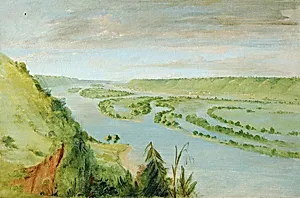
“Prairie du Chien has been one of the earliest and principal trading posts of the Fur Company, and they now have a large establishment at that place; but doing far less business than formerly, owing to the great mortality of the Indians in its vicinity, and the destruction of the game, which has almost entirely disappeared in these regions. The prairie is a beautiful elevation above the river, of several miles in length, and a mile or so in width, with a most picturesque range of grassy bluffs e...
Art Historical Context
George Catlin's *Prairie du Chien, United States Garrison* (1835-1836) captures a pivotal frontier landscape in present-day Wisconsin during the height of the American fur trade era. As a pioneering artist and ethnographer, Catlin traveled extensively in the 1830s to document the vanishing world of Native American life and the untamed West. This oil painting depicts the scenic prairie overlooking the Mississippi River, framed by grassy bluffs, with the sturdy U.S. garrison fort in the foreground—a symbol of expanding American military presence. Historically, Prairie du Chien was one of the earliest and busiest trading posts for the American Fur Company, but by Catlin's 1835 visit, its prosperity had waned due to devastating mortality among local Indigenous tribes from disease and the near-extinction of game. The fort housed several companies of soldiers tasked with maintaining peace among rival tribes and shielding settlers from potential attacks. Catlin's on-site sketches, later refined into this work, reflect his urgent mission to preserve these scenes amid rapid cultural and ecological changes. Rendered with Catlin's characteristic attention to naturalistic detail and atmospheric light, the painting evokes the romantic allure of the frontier while underscoring its tensions. Today, it offers museum visitors a vivid window into 19th-century expansionism and the fragile balance between wilderness, commerce, and conflict.
About the Artist
George Catlin · 1796–1872
George Catlin (1796–1872), born in Wilkes-Barre, Pennsylvania, to Putnam Catlin and Polly Sutton—who had been captured by Native Americans during the 1778 Battle of Wyoming—initially pursued a legal career. Trained at Litchfield Law School, he was admitted to the bar in 1819 but abandoned law after two years to study art in Philadelphia in 1823. Self-taught as a portraitist, Catlin quickly gained ...