
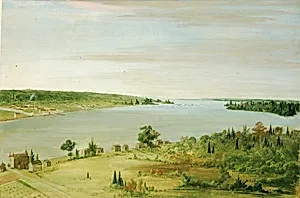
Sault Ste. Marie, Showing the United States Garrison in the Distance
1836-1837
Medium
Painting
Classification
Painting
Department
Smithsonian Collection
Museum
Smithsonian American Art Museum
Credit
Smithsonian American Art Museum, Gift of Mrs. Joseph Harrison, Jr.
Accession Number
1985.66.339
Rights
Public Domain
Tags
About this artwork
George Catlin described this painting as “a view of the Sault de St. Marys, taken from the Canada shore, near the missionary-house, which is seen in the fore-ground of the picture, and in the distance, the United States Garrison, and the Rapids; and beyond them the Capes at the outlet of Lake Superior.” (Catlin, Letters and Notes, vol. 2, no. 54, 1841; reprint 1973)
Art Historical Context
George Catlin's *Sault Ste. Marie Showing the United States Garrison the Distance* (1836–1837) captures a vivid panoramic view from the Canadian shore of the. Marys River rapids, a vital waterway linking Lake Superior and Lake Huron In the foreground stands a missionary house, symbolizing early European religious outreach, while the distant U.S. garrison and churning rapids evoke the tense border dynamics between Canada and the expanding American frontier. Beyond them, the capes mark Lake Superior's outlet, framing a scene of natural power and human encroachment. Catlin, a pioneering artist of the American West, painted this during his travels to document Native American life and landscapes before industrialization transformed them. As he described in his *Letters and Notes* (1841): “a view of the Sault de St. Marys... the United States Garrison, and the Rapids; and beyond them the Capes at the outlet of Lake Superior.” This oil painting reflects his realistic style, blending meticulous detail with romantic awe for the wilderness, part of his broader effort to preserve vanishing scenes amid westward expansion and military presence. Housed in the Smithsonian American Art Museum, this work highlights Sault Ste. Marie's role as a fur trade hub and strategic fort site, offering visitors a window into 19th-century North American borderlands where cultures, commerce, and conflict converged.
About the Artist
George Catlin · 1796–1872
George Catlin (1796–1872), born in Wilkes-Barre, Pennsylvania, to Putnam Catlin and Polly Sutton—who had been captured by Native Americans during the 1778 Battle of Wyoming—initially pursued a legal career. Trained at Litchfield Law School, he was admitted to the bar in 1819 but abandoned law after two years to study art in Philadelphia in 1823. Self-taught as a portraitist, Catlin quickly gained ...