
Quáy-hám-kay, Stone Shell, a Brave
1834
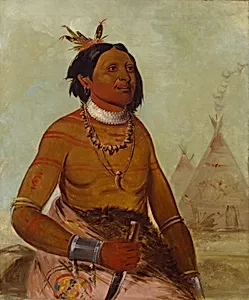
Medium
Painting
Classification
Painting
Department
Smithsonian Collection
Museum
Smithsonian American Art Museum
Credit
Smithsonian American Art Museum, Gift of Mrs. Joseph Harrison, Jr.
Accession Number
1985.66.65
Rights
Public Domain
Tags
About this artwork
George Catlin wrote that Stone Shell, a Kiowa brave, was “another fair specimen of the warriors of this tribe,” and that he was “somewhat allied to the mysteries and arcana of the healing art, from the close company he keeps with my friend Dr. Findley, who is surgeon to the regiment, and by whom I have been employed to make a copy of my portrait of this distinguished personage.” Catlin painted Stone Shell at a Comanche village in 1834. (Catlin, Letters and Notes, vol. 2, no. 43, 1841; reprint 19...
Art Historical Context
George Catlin's *Quáy-hám-kay, Stone Shell, a Brave (1834) captures the dignified likeness of a Kiowa warrior during Catlin's groundbreaking travels among Native American tribes in the American. As a pioneering artist and ethnographer, Catlin painted over 600 portraits in the 1830s to document Indigenous peoples before rapid cultural changes from European-American expansion. This oil portrait, now in the Smithsonian American Art Museum, exemplifies realistic style, emphasizing the subject's noble bearing and tribal regalia to convey authenticity and humanity. Catlin himself described Stone Shell as a "fair specimen of the warriors of this tribe," noting his connection to the "mysteries and arcana of the healing art" through friendship with army surgeon Dr. Findley. Painted at a Comanche village, the work highlights intertribal alliances on the Plains. Catlin even created a copy for the doctor, underscoring the portrait's role in bridging worlds. This piece holds profound historical and cultural significance, preserving a vanishing Kiowa identity amid 19th-century upheaval. For visitors, it offers a vivid window into Plains Indian life, blending artistry with urgent documentation.
About the Artist
George Catlin · 1796–1872
George Catlin (1796–1872), born in Wilkes-Barre, Pennsylvania, to Putnam Catlin and Polly Sutton—who had been captured by Native Americans during the 1778 Battle of Wyoming—initially pursued a legal career. Trained at Litchfield Law School, he was admitted to the bar in 1819 but abandoned law after two years to study art in Philadelphia in 1823. Self-taught as a portraitist, Catlin quickly gained ...