
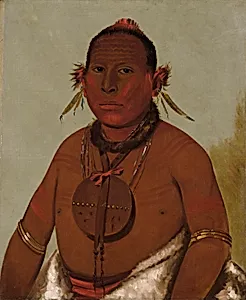
Wa-sáw-me-saw, Roaring Thunder, Youngest Son of Black Hawk
1832
Medium
Painting
Classification
Painting
Department
Smithsonian Collection
Museum
Smithsonian American Art Museum
Credit
Smithsonian American Art Museum, Gift of Mrs. Joseph Harrison, Jr.
Accession Number
1985.66.4
Rights
Public Domain
Tags
About this artwork
“I painted also the following portraits, which are now in my Collection . . . Wa-saw-me-saw (the roaring thunder), youngest son of Black Hawk; painted while prisoner of war.” (Catlin, Letters and Notes, vol. 2, no. 56, 1841; reprint 1973)
Art Historical Context
In 1832, American artist George Catlin captured the dignified likeness of Wa-sáw-me-saw, known as "Roaring Thunder the youngest son of the Sauk leader Black Hawk. This bust-length portrait, painted in oil, depicts the young warrior in traditional Indian dress, embodying Catlin's signature style of realistic, empathetic portrayals of Native Americans. As a pioneering figure in 19th-century American art, Catlin traveled extensively across the frontier to document Indigenous peoples, creating over 600 portraits now treasured in collections like the Smithsonian American Art Museum. The painting holds profound historical significance, created while Wa-sáw-me-saw was held as a prisoner of war following the Black Hawk War—a desperate Sauk and Fox resistance against U.S. expansion into Illinois and Wisconsin territories. Catlin himself noted in his *Letters and Notes* (1841) that he painted the portrait amid the captives' confinement, preserving a moment of cultural resilience. Today, gifted to the Smithsonian by Mrs. Joseph Harrison, Jr., it serves as a poignant reminder of the human stories behind America's turbulent westward expansion, highlighting Native dignity amid adversity.
About the Artist
George Catlin · 1796–1872
George Catlin (1796–1872), born in Wilkes-Barre, Pennsylvania, to Putnam Catlin and Polly Sutton—who had been captured by Native Americans during the 1778 Battle of Wyoming—initially pursued a legal career. Trained at Litchfield Law School, he was admitted to the bar in 1819 but abandoned law after two years to study art in Philadelphia in 1823. Self-taught as a portraitist, Catlin quickly gained ...