
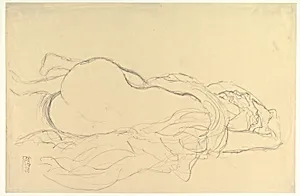
Reclining Nude with Drapery, Back View
1917–1918
Medium
Graphite
Dimensions
Sheet: 14 5/8 × 22 3/8 in. (37.1 × 56.8 cm) Frame: 23 × 29 × 1 1/2 in. (58.4 × 73.7 × 3.8 cm)
Classification
Drawings
Department
Drawings and Prints
Museum
Metropolitan Museum of Art, New York, NY
Credit
Bequest of Scofield Thayer, 1982
Accession Number
1984.433.196
Rights
Public Domain
Tags
Art Historical Context
Gustav Klimt's *Reclining Nude with Drapery, Back* (1917–1918) captures the artist's fascination with the female form in one of his final graphite drawings. Created during the waning months of World War I, Klimt was in his mid-50s and reflecting on a career defined by the Vienna Secession Art Nouveau, this work exemplifies his late-period shift toward intimate, preparatory studies. Unlike his opulent gold-leaf paintings like *The Kiss*, this delicate graphite sketch emphasizes fluid lines and subtle shading, revealing the nude's graceful curve from behind, with drapery adding a tactile contrast. As a drawing from the Metropolitan Museum of Art's Drawings and Prints department—acquired through the 1982 bequest of Scofield Thayer—this piece highlights Klimt's mastery of the medium. Graphite allowed him to explore anatomy with precision and sensuality, often as studies for larger oils. Measuring 14⅝ × 22⅜ inches, its scale invites close contemplation of the model's relaxed pose, evoking both eroticism and classical reverence for the body. Klimt produced hundreds of such nudes, pushing boundaries in early 20th-century Austria amid cultural shifts toward modernism. For visitors, this back-view nude offers a rare glimpse into Klimt's private process, blending beauty, vulnerability, and artistic innovation on a single sheet of paper.
About the Artist
Gustav Klimt · 1862–1918
Gustav Klimt was born on July 14, 1862, in Baumgarten near Vienna, the second of seven children in a modest family of artistic bent. His father, Ernst Klimt, a gold engraver who had immigrated from Bohemia, and his mother, Anna Finster, an aspiring musician, instilled an early appreciation for craft and creativity amid financial hardship. Klimt displayed prodigious drawing talent, prompting his en...