
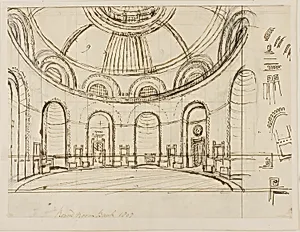
Round Room Bank
Medium
Pen and brown ink and graphite, on cream wove paper
Dimensions
22.7 × 30.4 cm (8 15/16 × 12 in.)
Classification
pen and ink drawings
Department
Prints and Drawings
Museum
Art Institute of Chicago
Accession Number
113201
Rights
Public Domain
Art Historical Context
Augustus Charles Pugin's *Round Room Bank* (1807) is a delicate pen and brown ink drawing heightened with graphite on cream wove paper, measuring 22.7 × 30.4 cm. Housed in the Art Institute of Chicago's Prints and Drawings department, this work exemplifies Pugin's mastery as an architectural illustrator during the early 19th century. As a key figure in Britain's burgeoning interest in topographic accuracy, Pugin (1762–1832), father of the famed Gothic Revival architect A.W.N. Pugin, specialized in capturing the grandeur of public buildings and interiors for publications like Rudolph Ackermann's *Microcosm of London*. Created amid the Regency era's architectural boom, the drawing likely depicts an elegant banking interior, reflecting the neoclassical influences shaping London's financial districts. Pugin's precise pen lines delineate architectural details with architectural fidelity, while subtle graphite shading adds depth and luminosity, techniques ideal for reproductive engravings in illustrated books. Wove paper's smooth texture enhanced such fine work, making it prized for detailed studies. This piece offers a window into 1807 urban life, showcasing how artists like Pugin preserved vanishing architectural nuances for posterity. Its classification as a pen and ink drawing underscores its role in bridging fine art and documentation, inviting visitors to appreciate the intricate interplay of line and tone in everyday opulence.
About the Artist
Augustus Charles Pugin · 1762–1832
Augustus Charles Pugin (1762–1832) was a pioneering architectural draughtsman and engraver whose meticulous illustrations played a pivotal role in reviving interest in Britain's medieval Gothic heritage. Born in France, Pugin relocated to London around 1792, where he quickly established himself as a master of topographical and architectural rendering. Working primarily in engraving and watercolor,...