
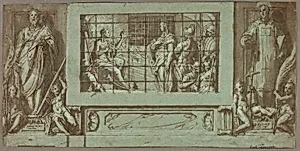
Saint Catherine in Prison Converting the Empress Faustina to Christianity, Flanked by Saints Saturnius and Simon
1570/71
Medium
Pen and brown ink, with brush and brown wash, heightened with lead white gouache, on blue laid paper
Dimensions
Sight: 19.6 × 39.5 cm (7 3/4 × 15 9/16 in.)
Classification
pen and ink drawings
Department
Prints and Drawings
Museum
Art Institute of Chicago
Accession Number
223807
Rights
Public Domain
About this artwork
This is an early developed compositional modello for the fresco in the choir of the church of Santa Caterina dei Funari, Rome, datable to 1570/71—a commission that Livio Agresti began (see adjacent drawing) and Federico finished. Ultimately, the fresco was changed from a basamento to an overdoor, as documented by two further studies. Like the Livio Agresti drawing on view nearby, this multilayered work shows Saint Catherine continuing to fight for her cause even while behind bars. The blue paper...
Art Historical Context
Federico Zuccaro, a leading Italian Mannerist artist active in the late 16th century, created this dynamic drawing around 1570–71. Titled *Saint Catherine in Prison Converting the Empress Faustina to Christianity, Flanked by Saints Saturnius and Simon*, it captures a dramatic moment from the golden legend of Saint Catherine of Alexandria. Imprisoned for her faith, the saint miraculously converts Empress Faustina, with the flanking saints Saturnius and Simon adding a sense of divine support and communal witness. Zuccaro's composition reflects the Counter-Reformation's emphasis on heroic martyrdom and conversion, themes resonant in post-Tridentine Europe. Executed in pen and brown ink with brush and brown wash, heightened with lead white gouache on striking blue laid paper, the work showcases Zuccaro's mastery of mixed media. The blue ground provides a luminous backdrop, enhancing the figures' sculptural volume through strategic highlights and shadows—a technique favored by Mannerist draughtsmen for its theatrical depth. At 19.6 × 39.5 cm, this preparatory sheet likely served as a modello for larger frescoes or altarpieces, revealing the artist's fluid linework and expressive gestures. Housed in the Art Institute of Chicago's Prints and Drawings department, this gem offers insight into Zuccaro's Roman training under his brother Taddeo and his travels across Europe. It invites visitors to appreciate how such intimate drawings bridged the gap between sketch and grand narrative painting, embodying the era's blend of piety and artistic virtuosity.
About the Artist
Federico Zuccaro · 1542–1609
Federico Zuccari, born around 1540 or 1541 in Sant'Angelo in Vado near Urbino, emerged as one of the leading figures of late Mannerism, the younger brother of the acclaimed painter Taddeo Zuccari. The son of a modest painter, Ottaviano, he moved to Rome at age 11, where he studied under his elder brother Taddeo in his bustling workshop, assisting on major commissions and honing his skills in fresc...