
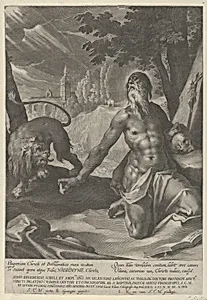
Saint Jerome in the Desert
Medium
Engraving
Dimensions
Sheet: 13 1/4 × 9 1/8 in. (33.7 × 23.2 cm)
Classification
Prints
Department
Drawings and Prints
Museum
Metropolitan Museum of Art, New York, NY
Credit
The Elisha Whittelsey Collection, The Elisha Whittelsey Fund, 1949
Accession Number
49.95.1872
Rights
Public Domain
Tags
Art Historical Context
This engraving portrays Saint Jerome in the desert, the early Christian scholar and translator of the Bible shown in a moment of penitential solitude. Accompanied by a lion—drawn from the legend of the saint removing a thorn from the animal’s paw—and surrounded by skulls that evoke themes of mortality, the composition emphasizes Jerome’s life of ascetic withdrawal and spiritual contemplation. Created in 1610 by German engraver Lucas Kilian after a design by Flemish artist Bartholomeus Spranger, the print exemplifies the reproductive role of engraving in the early seventeenth century. Spranger’s elegant, elongated figures reflect Northern Mannerist sensibilities, while Kilian’s precise line work translates those forms into a medium that allowed such imagery to circulate widely among collectors and scholars. Now part of the Metropolitan Museum of Art’s collection of prints and drawings, the sheet demonstrates how printmaking bridged painting and popular devotion, preserving vivid religious narratives for audiences beyond the original painting’s location.
About the Artist
Lucas Kilian|Bartholomeus Spranger · 1579–1637
Lucas Kilian (1579–1637) was one of the most celebrated engravers of early 17th-century Germany and the most prominent member of the Kilian dynasty of printmakers in Augsburg. Born in Augsburg in 1579, Lucas Kilian achieved international recognition for his technically virtuosic engravings and became a leading figure in the transition from late Renaissance to early Baroque printmaking styles. His ...