
Saint John the Baptist with Lamb
n.d.
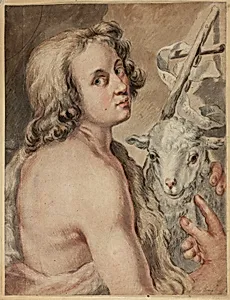
Medium
Watercolor over black chalk, on tan laid paper, tipped onto cream laid paper
Dimensions
33.6 × 25.5 cm (13 1/4 × 10 1/16 in.)
Classification
watercolor
Department
Prints and Drawings
Museum
Art Institute of Chicago
Accession Number
114862
Rights
Public Domain
Art Historical Context
In the serene watercolor *Saint John the Baptist with Lamb*, Carlo Cignani captures the humility and prophetic grace of the biblical figure, often depicted with a lamb as a symbol of Christ, the "Lamb of God." Cignani (1628–1714), a leading master of the Bolognese Baroque school, was renowned for his elegant, refined religious subjects influenced by the Carracci family. This undated preparatory study, housed in the Art Institute of Chicago's Prints and Drawings department, exemplifies his skill in devotional imagery during an era when such works bridged studio practice and altarpiece commissions. Executed in watercolor over black chalk on tan laid paper (33.6 × 25.5 cm), the piece showcases Cignani's masterful technique: the chalk provides fluid underdrawing for contours and shading, while translucent watercolor layers add luminous depth and subtle color to the saint's flowing robes and gentle expression. Laid paper, with its visible chain lines, was a favored support for draftsmen of the 17th century, allowing portability and repeated reworking. Tipped onto cream laid paper for conservation, it highlights the fragility and value of these intimate sketches. This artwork offers a window into Baroque devotional art, where saints like John embodied spiritual preparation amid Counter-Reformation fervor. Visitors can appreciate how Cignani's delicate touch transforms a simple study into a poignant meditation on faith and sacrifice.
About the Artist
Carlo Cignani · 1628–1719
Painter who continued the tradition of Bolognese classicism into the 18th century. He became the first president of the Accademia Clementina in 1711. His style is similar to that of Guido Reni. Comment on works: Mythology; Religious.