
Saint Thomas
n.d.
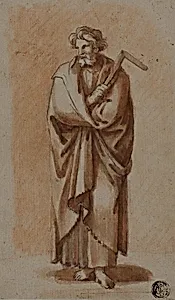
Medium
Graphite and brush and brownish orange wash, with red chalk, on cream laid paper, laid down on ivory wove paper
Dimensions
17.1 × 10.2 cm (6 3/4 × 4 1/16 in.)
Classification
graphite
Department
Prints and Drawings
Museum
Art Institute of Chicago
Accession Number
81199
Rights
Public Domain
Art Historical Context
In the Prints and Drawings department of the Institute of Chicago resides a delicate preparatory study, *Saint Thomas*, attributed to the High Renaissance master Raphael (1483–0). Rendered on cream laid paper and later laid down on ivoryove paper, this intimate sheet measures just 17.1 × 10.2 cm, the apostle Saint Thomas—often depicted as the doubting disciple—in a moment of quiet contemplation. Raphael's genius for anatomical precision and expressive pose shines through, reflecting his pivotal role in bridging the Early and High Renaissance with works like the *School of Athens*. The drawing employs a sophisticated mixed-media technique: graphite for fine lines and modeling, brush with brownish orange wash for subtle tonal depth, and red chalk for accents that enliven the figure's drapery and form. Such methods were hallmarks of Raphael's studio practice, allowing rapid exploration of compositions for larger paintings or frescoes. Though undated (n.d.), it exemplifies the Renaissance emphasis on drawing as the foundation of painting, prized by collectors for its spontaneity and mastery. This gem offers visitors a rare glimpse into Raphael's creative process, where saints like Thomas embodied spiritual inquiry amid humanism's rise. Its survival underscores the enduring value of Old Master drawings as windows into artistic innovation.
About the Artist
Raphael · 1483–1520
Raffaello Sanzio da Urbino, known simply as Raphael, was born on March 28 or April 6, 1483, in the cultured Duchy of Urbino to the court painter and poet Giovanni Santi and his wife Màgia Ciarla. Orphaned young—his mother died when he was eight and his father when he was eleven—Raphael was raised in Urbino's refined court under the guardianship of his paternal uncle Bartolomeo. He received his ear...