
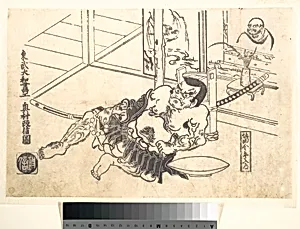
Sakata Kinpira Nyudo
early 18th century
Medium
Monochrome woodblock print; ink and color on paper
Dimensions
9 7/8 x 14 3/4 in. (25.1 x 37.5 cm)
Classification
Prints
Culture & Period
Japan · Edo period (1615–1868)
Department
Asian Art
Museum
Metropolitan Museum of Art, New York, NY
Credit
Gift of Estate of Samuel Isham, 1914
Accession Number
JP816
Rights
Public Domain
Tags
Art Historical Context
In the vibrant world of Edo-period Japan (1615–1868), Okumura Masobu's *Sakata Kinpira Ny* captures the heroic swagger of a legendary figure from folklore. Created in the early 18th, this woodblock print Sakata Kinpira, a fierce disciple of the superhuman warrior Sakataintoki, often portrayed in kabuki theater as a sword-wielding strongman. Masanobu, a pioneering ukiyo-e artist, masterfully renders the muscular nyudo (lay monk) in dynamic pose, sword at the ready, embodying the era's fascination with larger-than-life heroes and theatrical bravado. This monochrome print, executed in ink and subtle color on paper (measuring 9 7/8 x 14 3/4 in.), showcases Masanobu's innovative techniques. As one of the first to experiment with multi-color woodblocks like benizuri-e (crimson-printed pictures), he pushed beyond traditional black-and-white sumizuri-e, adding depth and gloss through careful layering. Woodblock printing revolutionized Japanese art by enabling affordable, mass-produced images that brought popular culture— from kabuki stars to mythical warriors—into everyday life. Housed in the Metropolitan Museum of Art's Asian Art Department, this gift from the Estate of Samuel Isham in 1914 highlights the global appeal of ukiyo-e's "floating world." Kinpira's bold presence not only reflects samurai ideals of strength and loyalty but also invites viewers to step into Japan's playful, print-saturated urban culture of the time.
About the Artist
Okumura Masanobu · 1686–1764
Japanese, 1686–1764