
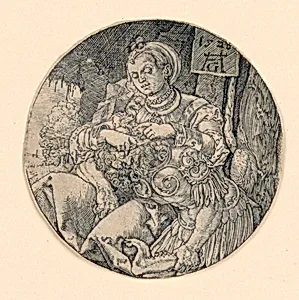
Samson and Delilah
Classification
Department
Smithsonian Collection
Museum
Smithsonian American Art Museum
Credit
Bequest of George Campbell Cooper
Accession Number
1896-3-85
Rights
Public Domain
About this artwork
Research in Progress
Art Historical Context
Heinrich Aldegrever's *Samson and Delilah* (1528) captures a dramatic biblical moment from the Book of Judges, where the mighty hero Samson falls victim to his lover Delilah's betrayal. As she shears his hair—the source of his supernatural strength—Aldegrever freezes this tale of love, deception, and downfall in a finely wrought print. Created during the Northern Renaissance, the work reflects the era's fascination with moral narratives drawn from scripture, which resonated deeply amid the Protestant Reformation's emphasis on personal faith and biblical storytelling. Aldegrever, a German engraver from Soest (1502–c.1561), was a key figure among the "Little Masters," renowned for their intricate small-scale prints that rivaled painting in detail. Though the exact medium here remains under study, such works typically employed engraving techniques, allowing precise lines and textures to convey emotion and narrative depth. These affordable prints democratized art, spreading Renaissance ideals across Europe and influencing collectors far beyond Germany. Housed in the Smithsonian American Art Museum through the bequest of George Campbell Cooper, this piece highlights the enduring cross-cultural appeal of Aldegrever's craftsmanship. Visitors can appreciate how it bridges artistry and spirituality, inviting reflection on human vulnerability in a format both intimate and profound. (198 words)