
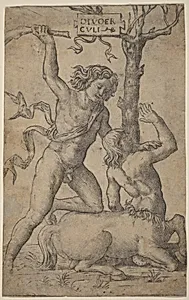
Hercules and Nessus
c. 1504/1509
Medium
engraving
Dimensions
sheet: 17.1 x 10.9 cm (6 3/4 x 4 5/16 in.)
Classification
Department
CG-E
Museum
National Gallery of Art, Washington, D.C.
Credit
Rosenwald Collection
Accession Number
1943.3.9074
Rights
Public Domain
Art Historical Context
Behold the dramatic engraving *Hercules andus* by Marcantonio Raim, created around 1504–1509. This intimate sheet, measuring just 17.1 x 10. cm, captures a pivotal moment from Greek mythology: the hero Hercules slaying the centaur Ness, who had attempted to abduct his wife Deianira.ondi's masterful composition conveys raw power and tension through intricate lines, drawing viewers into the ancient tale of heroism and betrayal. As one of the greatest engravers of the Renaissance, Raimondi revolutionized printmaking in early 16th-century Italy. Working primarily in Venice and Rome, he excelled at translating paintings and drawings into engravings—intaglio prints made by incising designs into copper plates with a burin, then inking and pressing onto paper. This technique allowed unprecedented detail and tonal depth, making high art accessible beyond elite patrons. Housed in the National Gallery of Art's Rosenwald Collection, this work exemplifies the era's revival of classical themes and the explosive growth of prints as a democratic medium. Raimondi's innovations helped disseminate Renaissance ideals across Europe, bridging antiquity with the modern age. A testament to technical virtuosity, it invites us to ponder the timeless clash of man and myth.
About the Artist
Marcantonio Raimondi · 1475–1534
Marcantonio Raimondi (c. 1480–1534), born near Bologna, Italy, emerged as one of the Renaissance's premier engravers, revolutionizing printmaking through his mastery of reproductive techniques. He trained in the workshop of the goldsmith, painter, and niellist Francesco Francia, whose influence is evident in his early engravings, such as the goldsmith-like shading in *Pyramus and Thisbe* (1505), h...