
Satyr Family
1505
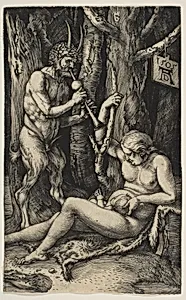
Medium
Engraving
Dimensions
sheet: 4 1/2 x 2 13/16 in. (11.4 x 7.1 cm) trimmed to plate line at top and sides; clipped at bottom
Classification
Prints
Department
Drawings and Prints
Museum
Metropolitan Museum of Art, New York, NY
Credit
Fletcher Fund, 1919
Accession Number
19.73.77
Rights
Public Domain
Tags
Art Historical Context
Albrecht Dürer, the preeminent German artist of the Northern Renaissance, created *Satyr Family* in1505 as a masterful engraving. This intimate print, measuring just 4½ x 2⅞ inches, captures a whimsical mythological scene featuring satyrs—half-human, half-goat creatures from ancient Greek lore—alongside female nudes and playful infants. Produced during Dürer's mature period, when he was at the height of his fame in Nuremberg, the work reflects the Renaissance fascination with classical antiquity, blending pagan revelry with precise Northern European naturalism. Dürer's engraving technique shines here: using a burin to incise fine lines into a copper plate, he achieved extraordinary detail and tonal depth in such a tiny format. The trimmed sheet, clipped at the bottom, hints at its handling as a cherished collector's item over centuries. Satyrs, symbols of untamed wilderness and Dionysian ecstasy, are humanized in a tender family moment, showcasing Dürer's skill in conveying emotion and anatomy with scientific accuracy. Housed in the Metropolitan Museum of Art's Drawings and Prints department (Fletcher Fund, 1919), this rare gem exemplifies how prints democratized art, allowing widespread appreciation of Dürer's genius beyond paintings. Visitors are drawn to its mischievous charm, a window into 16th-century imagination.
About the Artist
Albrecht Dürer · 1471–1528
Albrecht Dürer (1471–1528) stands as the preeminent figure of the Northern Renaissance and arguably the most influential artist in the history of printmaking. Born in Nuremberg on May 21, 1471, and dying in the same city on April 6, 1528, Dürer revolutionized the status of the artist in Northern Europe, transforming printmaking from a commercial craft into an independent fine art and establishing ...