
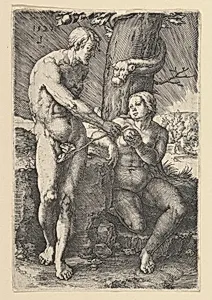
Sin of Adam and Eve
1529
Medium
Engraving
Classification
Prints
Department
Drawings and Prints
Museum
Metropolitan Museum of Art, New York, NY
Credit
Harris Brisbane Dick Fund, 1930
Accession Number
30.24.2
Rights
Public Domain
Tags
Art Historical Context
In the intricate engraving *Sin of Adam and Eve* (1529), Dutch Northern Renaissance master Lucas van Leyden captures the pivotal biblical moment of temptation in the Garden of Eden. Adam and Eve stand amidst lush foliage, confronted by the cunning serpent—a vivid embodiment of original sin from Genesis. Van Leyden, aigy who died young at 39, was celebrated for his narrative prints that rivaled Albrecht Dürer's in precision and storytelling, blending moral allegory with everyday human drama. This work exemplifies engraving's revolutionary potential in the 16th century, where van Leyden's virtuoso use of fine lines and cross-hatching created depth, texture, and atmospheric light in a single copper plate. The coiled snake, tagged prominently alongside the central figures, heightens the scene's tension, drawing viewers into a cautionary tale of disobedience and humanity's fall. As a print, it was designed for wide dissemination, making profound religious themes accessible beyond elite patrons. Acquired by The Metropolitan Museum of Art in 1930 through the Harris Brisbane Dick Fund, this piece showcases van Leyden's enduring influence on printmaking, inviting us to reflect on timeless questions of temptation and consequence.
About the Artist
Lucas van Leyden · 1484–1533
Lucas van Leyden (1494–1533) was a Dutch painter and printmaker who stands among the greatest engravers of the Northern Renaissance. Born in Leiden as either Lucas Hugensz or Lucas Jacobsz, he lived and worked primarily in his native city, achieving international renown that rivaled the German master Albrecht Dürer. Lucas van Leyden revolutionized Netherlandish printmaking and was among the first...