
The Fall of Man
1529
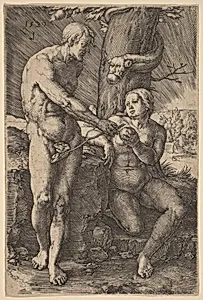
Medium
engraving
Dimensions
sheet (trimmed to plate mark): 11.8 x 7.8 cm (4 5/8 x 3 1/16 in.)
Classification
Department
CG-E
Museum
National Gallery of Art, Washington, D.C.
Credit
Rosenwald Collection
Accession Number
1943.3.5663
Rights
Public Domain
Art Historical Context
Behold *The Fall of Man*, a masterful 1529 engraving by Lucas van Leyden one of the Northern Renaissance's most celebrated Dutch printmakers. This intimate work, measuring just 11.8 x 7.8 cm, captures the biblical moment of Adam and Eve's expulsion from Eden, rendered with van Leyden's signature precision Active in Leiden during the early 16th century, drew inspiration from contemporaries like Albrecht Dürer, blending intricate detail with narrative drama in a compact format ideal for collectors and scholars. Van Leyden's engraving technique shines here: fine, cross-hatched lines create depth, texture, and subtle shading on the copper plate, allowing for multiple impressions that spread religious imagery across Europe amid the Reformation's fervor. Prints like this democratized art, making high-quality visuals accessible beyond oil paintings or frescoes. Housed in the National Gallery of Art's Rosenwald Collection, this piece exemplifies van Leyden's innovative genius—his last major series before his early death at 39. Visitors, marvel at how such a tiny sheet packs profound moral and artistic power, inviting reflection on humanity's timeless temptations.
About the Artist
Lucas van Leyden · 1484–1533
Lucas van Leyden (1494–1533) was a Dutch painter and printmaker who stands among the greatest engravers of the Northern Renaissance. Born in Leiden as either Lucas Hugensz or Lucas Jacobsz, he lived and worked primarily in his native city, achieving international renown that rivaled the German master Albrecht Dürer. Lucas van Leyden revolutionized Netherlandish printmaking and was among the first...