
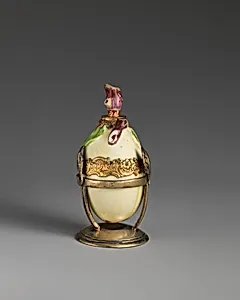
Scent bottle
ca. 1760
Medium
Soft-paste porcelain
Dimensions
Height (with stand): 2 3/4 in. (7 cm)
Classification
Ceramics-Porcelain
Culture
British, Chelsea
Department
European Sculpture and Decorative Arts
Museum
Metropolitan Museum of Art, New York, NY
Credit
Gift of Irwin Untermyer, 1971
Accession Number
1971.75.17a–c
Rights
Public Domain
Art Historical Context
This delicate scent bottle, crafted by the Chelsea Porcelainufactory around 176, exemplifies the pinnacle of British porcelain production. Standing just 2¾ inches tall on its stand, this soft-paste porcelain gem was designed as a luxurious personal accessory for holding perfume, reflecting the refined tastes of 18th-century. Chelsea, one of England's first porcelain factories founded in the 1740s, gained fame for rivaling continental makers like Meissen with its intricate, translucent wares. Soft-paste porcelain, the medium here, was a British innovation blending clay, glass frit, and other materials fired at lower temperatures than true hard-paste. This allowed for exceptional detail and vibrancy in modeling and enameling, though it was more fragile—a testament to Chelsea's skilled artisans during its "Gold Anchor" period of peak excellence. Such bottles often featured playful rococo motifs, underscoring the era's love for ornate, whimsical luxury goods amid the porcelain mania sweeping Europe. Housed in the Metropolitan Museum of Art's European Sculpture and Decorative Arts Department, this piece—gifted by Irwin Untermyer in 1971—highlights Chelsea's cultural role in elevating British ceramics to high art, bridging utility and elegance for the elite. A charming survivor of opulent drawing rooms!
About the Artist
Chelsea Porcelain Manufactory · 1744–1784
**Chelsea Porcelain Manufactory** The Chelsea Porcelain Manufactory, Britain's pioneering porcelain enterprise, was founded around 1743 in Chelsea, London, by two Huguenot silversmiths: Nicholas Sprimont from Liège and Charles Gouyn. Sprimont, trained in Paris as a goldsmith before immigrating to England, brought his expertise in luxury metalwork to the venture, while Gouyn handled early sales th...