
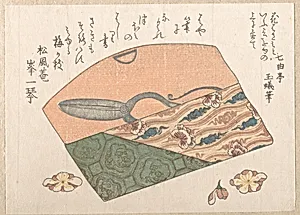
Scissors for Flower Arrangement with a Bag
early 19th century
Medium
Woodblock print (surimono); ink and color on paper
Dimensions
5 1/8 x 7 1/16 in. (13 x 17.9 cm)
Classification
Prints
Culture & Period
Japan · Edo period (1615–1868)
Department
Asian Art
Museum
Metropolitan Museum of Art, New York, NY
Credit
H. O. Havemeyer Collection, Bequest of Mrs. H. O. Havemeyer, 1929
Accession Number
JP2146
Rights
Public Domain
Tags
Art Historical Context
This delicate woodblock print, titledScissors for Flower Arrangement a Bag*, captures an unidentified artist's keen eye for everyday elegance in early 19th-century Japan. Created during the Edo period (161–1868), it showcases specialized scissors and a accompanying bag used in ikebana, the Japanese art of flower arranging. Rendered in vibrant ink and color on paper the intimate dimensions (5 1/8 x 7 1/16 in.) invite close contemplation, typical of surimono—privately commissioned prints produced for poetry gatherings, New Year's greetings, or subtle advertisements among the elite. Surimono elevated utilitarian objects like these tools into poetic symbols, reflecting Edo Japan's urban sophistication and appreciation for craftsmanship. Flower arrangement scissors, with their precise blades, were essential for ikebana masters, embodying harmony, asymmetry, and seasonal beauty central to Japanese aesthetics. The print's refined technique—likely featuring subtle embossing or mica for texture—highlights the woodblock medium's versatility, bridging fine art and commerce. Housed in the Metropolitan Museum of Art's Asian Art department as part of the H. O. Havemeyer Collection (1929), this piece offers a window into a cultured society's blend of practicality and artistry, reminding us how ordinary items could inspire profound creativity.