
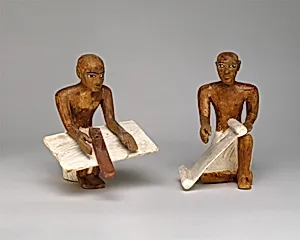
Scribes from Meketre's Model Granary
Unknown Artist
ca. 1981–1975 B.C.
Medium
Wood, plaster, paint, linen
Dimensions
H. of right-hand figure: 15.5 cm (6 1/8 in.)
Classification
Model, granary, Meketre
Period
Middle Kingdom
Department
Egyptian Art
Museum
Metropolitan Museum of Art, New York, NY
Credit
Rogers Fund and Edward S. Harkness Gift, 1920
Accession Number
20.3.11-SCRIBES
Rights
Public Domain
Tags
Art Historical Context
These small wooden figures of scribes come from a model granary created around 1981–1975 B.C. during Egypt’s Middle Kingdom, Dynasty 12. Part of a larger set of tomb models belonging to the high official Meketre, they were discovered in his Theban tomb and entered the Metropolitan Museum’s collection in 1920. Such models were placed in burials to ensure the deceased would have a continuous supply of grain and the administrative staff needed to manage it in the afterlife. The scribes, just 15.5 cm tall, are carved from wood, coated with plaster, painted, and finished with linen details. Their alert postures and the miniature writing tools they hold capture the essential role of record-keeping in ancient Egyptian society. By depicting daily activities like grain storage and accounting, the models offer a vivid glimpse into the organized economy that supported the pharaoh’s court and temples. Beyond their practical purpose, these figures reveal the high value placed on literacy and precision during the Middle Kingdom, a period of renewed stability and artistic refinement. Their survival allows modern visitors to appreciate both the technical skill of Egyptian artisans and the cultural belief that carefully crafted replicas could sustain life beyond death.