
Sháw-da-mon-nee, There He Goes, a Brave
1832
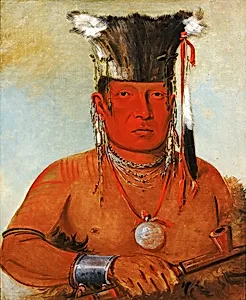
Medium
Painting
Classification
Painting
Department
Smithsonian Collection
Museum
Smithsonian American Art Museum
Credit
Smithsonian American Art Museum, Gift of Mrs. Joseph Harrison, Jr.
Accession Number
1985.66.115
Rights
Public Domain
Tags
About this artwork
“I have visited forty-eight different tribes, the greater part of which I found speaking different languages, and containing in all 400,000 souls. I have brought home safe, and in good order, 310 portraits in oil, all painted in their native dress, and in their own wigwams . . . as well as a very extensive and curious collection of their costumes, and all their other manufactures, from the size of a wigwam down to the size of a quill or a rattle.” George Catlin probably painted Omaha brave There...
Art Historical Context
**Sháw-da-mon-nee, There He Goes, a Brave** (1832) is a striking oil portrait by George Catlin, the pioneering American artist who dedicated his career to documenting Native American life. Capturing the dignified Omaha brave Sháw-da-mon-nee—whose name translates to "There He Goes"—in his native dress, this painting exemplifies Catlin's commitment to authenticity. Painted likely at Fort Leavenworth in present-day Kansas, it forms part of his ambitious project to portray Indigenous peoples before rapid cultural changes from westward expansion. Catlin's journeys took him to 48 tribes, where he painted 310 oil portraits in situ, within wigwams, alongside collecting costumes and artifacts. As he wrote in his 1841 *Letters and Notes*, these works preserved the "400,000 souls" of diverse nations speaking different languages. His realist style emphasized direct observation, rendering subjects with vivid detail and personal presence, free from European romanticism. Housed in the Smithsonian American Art Museum, this portrait holds profound historical significance as a firsthand record of Omaha culture in 1832. It invites visitors to reflect on the bravery and resilience of Native individuals amid encroaching settlement, offering a window into a vanishing world through Catlin's empathetic lens. (198 words)
About the Artist
George Catlin · 1796–1872
George Catlin (1796–1872), born in Wilkes-Barre, Pennsylvania, to Putnam Catlin and Polly Sutton—who had been captured by Native Americans during the 1778 Battle of Wyoming—initially pursued a legal career. Trained at Litchfield Law School, he was admitted to the bar in 1819 but abandoned law after two years to study art in Philadelphia in 1823. Self-taught as a portraitist, Catlin quickly gained ...