
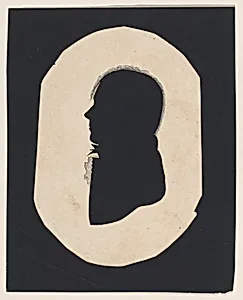
Silhouette of an unknown man
1803–21
Medium
Hollow cut paper with pen and ink additions
Dimensions
Sheet: 5 × 4 in. (12.7 × 10.2 cm)
Classification
Cut Paper|Ephemera
Department
Drawings and Prints
Museum
Metropolitan Museum of Art, New York, NY
Credit
The Glenn Tilley Morse Collection, Bequest of Glenn Tilley Morse, 1950
Accession Number
50.602.1421
Rights
Public Domain
Art Historical Context
Step into the delicate world of early 19th-century portraiture with *Silhouette of an Unknown Man* by Moses Chapman, created between 1803 and 1821. This petite work, measuring just 5 × 4 inches, captures the refined profile of an unidentified gentleman using hollow-cut paper—a clever technique where thin paper is meticulously incised to form a stark, shadowy likeness, enhanced by subtle pen and ink details for depth and expression. Silhouettes like this one exploded in popularity during the Federal period in America, offering an affordable alternative to oil portraits for the rising middle class. Chapman, a skilled itinerant artist, mastered this ephemera art form, producing quick, evocative mementos at fairs, homes, and events. The "hollow-cut" method, distinct from flat silhouettes, creates a nuanced, almost sculptural effect by removing interior paper, allowing light to play across the form when backed appropriately. Housed in the Metropolitan Museum of Art's Drawings and Prints department from the Glenn Tilley Morse Collection, this piece highlights the democratic charm of vernacular art—ephemeral yet enduring, it preserves a fleeting moment of identity in black and white elegance.