
Six Vignettes
n.d.
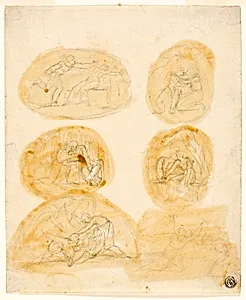
Medium
Graphite, brushed with shellac, on ivory laid paper
Dimensions
22.9 × 18.8 cm (9 1/16 × 7 7/16 in.)
Classification
graphite
Department
Prints and Drawings
Museum
Art Institute of Chicago
Accession Number
83418
Rights
Public Domain
Art Historical Context
Thomas Stothard (1755–1834), a prolific British artist celebrated for his delicate illustrations and history paintings, created *Six Vignettes*, a undated drawing that exemplifies his mastery of miniature narrative scenes. Active during the late 18 and early 19th centuries, Stothard was a key figure in the Romantic era's illustrative tradition, often contributing vignettes—small, evocative compositions—to books and prints. These six vignettes likely depict whimsical or literary subjects, showcasing his fluid line work and imaginative storytelling, which graced publications by authors like John Milton and William Shakespeare. Executed in graphite heightened with brushed shellac on ivory laid paper, the work measures a compact 22.9 × 18.8 cm, ideal for intimate study or reproduction. Graphite allowed Stothard’s precise, expressive lines, while shellac provided a glossy fixative, enhancing luminosity and preserving the delicate tones on the creamy ivory paper—a premium support favored by British draftsmen for its texture and durability. This technique underscores the era's advances in drawing materials, bridging sketch and finished artwork. Housed in the Art Institute of Chicago's Prints and Drawings Department, *Six Vignettes* offers a window into Regency-period book culture, where such vignettes enlivened pages with subtle drama. Visitors will appreciate Stothard’s ability to pack emotion into tiny frames, a testament to his enduring influence on British illustration.
About the Artist
Thomas Stothard · 1755–1834
Thomas Stothard RA (1755–1834) was born on 17 August 1755 at the Black Horse Inn in London's Long Acre, the son of a prosperous publican originally from Stutton near Tadcaster. A delicate child, he was sent at age five to relatives in Yorkshire, attending schools in Acomb, Tadcaster, and later Ilford, Essex, where he honed his drawing skills by copying prints. Following his father's death in 1770,...