
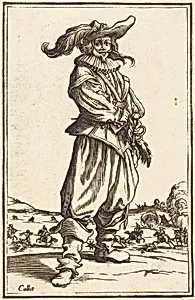
Soldier with Feathered Hat
1623 or later
Medium
woodcut on laid paper
Dimensions
image/block: 14.9 × 9.6 cm (5 7/8 × 3 3/4 in.) sheet: 17.3 × 11.2 cm (6 13/16 × 4 7/16 in.)
Classification
Department
CG-E
Museum
National Gallery of Art, Washington, D.C.
Credit
R.L. Baumfeld Collection
Accession Number
1969.15.158
Rights
Public Domain
Art Historical Context
Behold the *Soldier with Feathered*, a captivating woodcut on laid paper created after the renowned French printmaker Jacques Callot around 1623 or later. Measuring just 14.9 × 9.6 cm for the image, this intimate print captures a jaunty soldier adorned with a plume-topped hat, evoking theoyant military fashion of early 17th-century Europe Callot, a master of intricate detail and dynamic composition, was celebrated for his small-scale prints that brought vivid scenes of soldiers, festivals, and hardships to life, influencing printmaking across the continent. As a woodcut—a relief printing technique where the artist carves away negative space from a woodblock—this work highlights the medium's accessibility and reproducibility, allowing widespread dissemination of Callot's imagery. Laid paper, with its characteristic ribbed texture from the manufacturing process, adds tactile authenticity to the piece. Produced amid the turmoil of the Thirty Years' War, such depictions romanticized the soldier's swagger while hinting at the era's martial culture. Part of the R.L. Baumfeld Collection at the National Gallery of Art, it exemplifies how prints democratized art, bridging elite workshops and everyday viewers. (198 words)
About the Artist
after Jacques Callot
**Jacques Callot (c. 1592–1635)**, the master whose designs inspired the works attributed "after Jacques Callot," was a pioneering French Baroque printmaker and draftsman born in Nancy, capital of the independent Duchy of Lorraine (now northeastern France). From a noble family—his father served as master of ceremonies and herald-at-arms to the Duke of Lorraine—young Callot was apprenticed to a gol...