
Sonnenblume
1907/1908
Medium
Öl und Blattgold auf Leinwand
Dimensions
110 x 110 cm
Classification
Gemälde
Department
Belvedere Collection
Museum
Belvedere
Credit
Belvedere, Vienna
Accession Number
10500
Rights
Public Domain
About this artwork
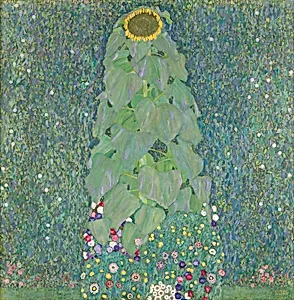
Gustav Klimt zeigt eine einzelne majestätische Sonnenblume inmitten dieser quadratischen Komposition, in der sich das Grün einer Hecke wie ein Musterteppich über die gesamte Bildfläche ausbreitet. Die Blüte leicht geneigt, scheint sie ihre Blätter wie zum Schutz über die bunten Sommerblumen zu wölben, die dicht gedrängt unter ihr wachsen. Tatsächlich wurde Klimts Sonnenblume immer wieder als menschenähnliche Gestalt gedeutet, die in ihrer Form an mittelalterliche Schutzmantelmadonnen erinnert: D...
Art Historical Context
In Gustav Klimt's *Sonnenblume* (Sunflower), created around 1907/1908, a single majestic sunflower commands the center of a perfectly square canvas, measuring 110 x 110 cm. Rendered in oil and shimmering gold leaf on canvas, painting exemplifies Klimt's signature style from Vienna's Secession movement—a blend of Art Nouveau elegance and symbolic depth. The flower's petals arch protectively over a vibrant cluster of summer blooms below, while a lush green hedge unfurls like an intricate patterned carpet across the, evoking the ornate decorative motifs Klimt adored. Art critics have long marveled at the flower's anthropomorphic presence, likening it to a medieval "Schutzmantelmadonna" (protective mantle Madonna), with its sheltering form guarding the flowers beneath. Secession critic Ludwig Hevesi poetically dubbed it a "verliebte Fee" (lovesick fairy), capturing its ethereal, almost mythical quality. Some interpreters even discern a subtle portrait of the influential designer Emilie Flöge, Klimt's close companion, hidden within its contours. This work, housed in Vienna's Belvedere Collection, reflects Klimt's fascination with nature as a vessel for human emotion and spirituality during his golden phase. Through its gilded surface and layered symbolism, *Sonnenblume* invites viewers to ponder the boundary between flora and figure, a testament to Klimt's enduring innovation in turn-of-the-century Austrian art.
About the Artist
Gustav Klimt · 1862–1918
Gustav Klimt was born on July 14, 1862, in Baumgarten near Vienna, the second of seven children in a modest family of artistic bent. His father, Ernst Klimt, a gold engraver who had immigrated from Bohemia, and his mother, Anna Finster, an aspiring musician, instilled an early appreciation for craft and creativity amid financial hardship. Klimt displayed prodigious drawing talent, prompting his en...