
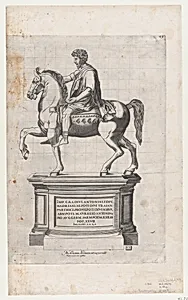
Speculum Romanae Magnificentiae: Marcus Aurelius
16th century
Medium
Engraving
Dimensions
sheet: 18 5/16 x 11 in. (46.5 x 28 cm) plate: 14 7/16 x 9 13/16 in. (36.7 x 25 cm) trimmed on the left-hand side
Classification
Prints
Department
Drawings and Prints
Museum
Metropolitan Museum of Art, New York, NY
Credit
Harris Brisbane Dick Fund, 1941
Accession Number
41.72(2.106)
Rights
Public Domain
Tags
Art Historical Context
Welcome to the Metropolitan Museum of Art's Drawings and Prints department, where you'll find *Speculum Romanae Magniae: Marcus Aurelius a captivating 16th-century engraving one of the era's most ambitious publishing ventures. The *Speculum Romanae Magniae*—or "Mirror of Roman Magnificence"—was a groundbreaking series of prints compiled by Antwerp publisher Antonio Lafreri, meticulously rendered images of ancient Roman antiquities, sculptures, and. This plate likely depicts the iconic equestrian statue of Emperor Marcus Aurelius (r. 161–180 CE), a symbol of imperial power and Stoic philosophy, perched triumphantly on horseback amid classical motifs. Engraved by a trio of Renaissance masters—Nicolas Beatrizet, Marco Dente, and Cornelis Bos—this work exemplifies the period's obsession with antiquity during the High Renaissance. Engraving, a precise intaglio technique where lines are incised into a metal plate and inked for transfer to paper, allowed for detailed reproduction and widespread dissemination of Rome's wonders. Trimmed on the left (sheet: 18 5/16 x 11 in.; plate: 14 7/16 x 9 13/16 in.), it captures the grandeur of ancient Rome for collectors and scholars, fueling the Renaissance revival of classical ideals. Acquired through the Harris Brisbane Dick Fund in 1941, this print bridges antiquity and the 16th century, reminding us how artists like Beatrizet and his collaborators preserved—and romanticized—Rome's legacy for future generations. A testament to printmaking's power!
About the Artist
Nicolas Beatrizet|Marco Dente|Cornelis Bos · 1515–1566
Nicolas Beatrizet, born around 1515 in Lunéville, Lorraine (then part of the Holy Roman Empire), emerged as one of the most prolific French engravers of the 16th century. Little is known about his early life and training, with no records of specific teachers or apprenticeships, though regional influences from German and Italian printmaking likely shaped his skills before he arrived in Rome around ...