
Speculum Romanae Magnificentiae: Nerva, from "The Twelve Caesars"
ca. 1500–1534
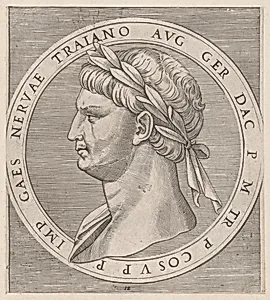
Medium
Engraving; second state of three
Dimensions
mount: 11 1/4 x 16 3/4 in. (28.5 x 42.6 cm) sheet: 6 5/8 x 5 7/8 in. (16.8 x 15 cm)
Classification
Prints
Department
Drawings and Prints
Museum
Metropolitan Museum of Art, New York, NY
Credit
Harris Brisbane Dick Fund, 1941
Accession Number
41.72(3.94)
Rights
Public Domain
Tags
Art Historical Context
Step into the Renaissance fascination with ancient Rome through *Speculum Romanaeificentiae: Nerva, from "The Twelve Caesars*, an exquisite engraving by Marcantonio Raim (ca. 1480–1534). This second-state print captures a profile portrait of the Roman emperor Nerva (r. 96–98 CE), one of the Twelve Caesars immortalized by Suetonius. Raimondi a pioneering Italian engraver closely associated with Raphael, masterfully translates classical busts into precise lines, evoking the grandeur of imperial Rome. The *Speculum Romanae Magnificentiae*, or "Mirror of Roman Magnificence," was a celebrated 16th-century series of over 600 prints produced in Rome, blending archaeology, portraiture, and architecture to celebrate antiquity during the High Renaissance. Raimondi's work exemplifies the era's revival of classical ideals, making elite imagery accessible via printmaking—a revolutionary medium that fueled the spread of humanism and antiquarianism across Europe. Crafted in engraving, an intaglio technique where intricate lines are incised into a copper plate for inked impressions, this modest sheet (6 5/8 x 5 7/8 in.) packs monumental impact. The second of three states likely features refined details from early proofs, showcasing Raimondi's technical virtuosity. Housed in The Metropolitan Museum of Art's Drawings and Prints department, it invites visitors to ponder how Renaissance artists like Raimondi bridged ancient emperors with modern audiences.
About the Artist
Marcantonio Raimondi · 1475–1534
Marcantonio Raimondi (c. 1480–1534), born near Bologna, Italy, emerged as one of the Renaissance's premier engravers, revolutionizing printmaking through his mastery of reproductive techniques. He trained in the workshop of the goldsmith, painter, and niellist Francesco Francia, whose influence is evident in his early engravings, such as the goldsmith-like shading in *Pyramus and Thisbe* (1505), h...