
竹に栗鼠図|Squirrels on Bamboo and Rock
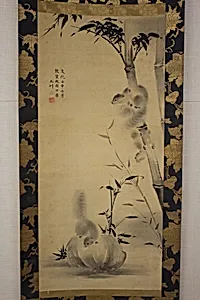
Medium
Hanging scroll; ink on silk
Dimensions
Image: 34 in. × 15 1/2 in. (86.4 × 39.4 cm) Overall with mounting: 67 1/4 × 20 in. (170.8 × 50.8 cm) Overall with knobs: 67 1/4 × 21 1/4 in. (170.8 × 54 cm)
Classification
Paintings
Culture & Period
Japan · Edo period (1615–1868)
Department
Asian Art
Museum
Metropolitan Museum of Art, New York, NY
Credit
Charles Stewart Smith Collection, Gift of Mrs. Charles Stewart Smith, Charles Stewart Smith Jr., and Howard Caswell Smith, in memory of Charles Stewart Smith, 1914
Accession Number
14.76.19
Rights
Public Domain
Tags
Art Historical Context
Mochizuki Gyok’s *Squirrels on Bamboo Rock* (1812) is a delicate hanging scroll painted in ink on silk, a lively moment in nature during Japan’s Edo period (161–1868). Created the artist also known as Yongtian this work measures 34 by 15½ inches in its image area, designed to be unrolled and displayed on special occasions in traditional Japanese homes or temples. The Edo era, a time of relative peace and cultural flourishing under the Tokugawa shogunate, saw a boom in such intimate nature paintings that celebrated the beauty of everyday flora and fauna. Rendered with precise ink brushwork, the scroll depicts playful squirrels scampering along sturdy bamboo stalks and rocky outcrops—a common motif symbolizing resilience (bamboo bends but does not break) and the joys of the natural world. Gyokusen’s technique highlights the silk medium’s luminosity, allowing subtle gradations of ink to evoke texture, from the rough bark to the squirrels’ fluffy fur. This piece reflects the period’s appreciation for harmonious, seasonal scenes, often evoking auspicious themes of abundance and vitality. Now housed in the Metropolitan Museum of Art’s Asian Art Department as part of the Charles Stewart Smith Collection (gifted in 1914), it invites viewers to pause and marvel at Edo Japan’s refined artistry, bridging East Asian traditions with universal delight in wildlife.
About the Artist
Mochizuki Gyokusen 望月玉川|Yongtian 用田 (Japanese|Chinese) · 1794 | –1852 |
Japanese, 1794–1852|Chinese, active late 13th–14th century