
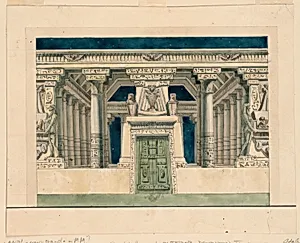
Stage Design, Egyptian Temple
ca. 1825
Classification
theater
Department
Smithsonian Collection
Museum
Smithsonian American Art Museum
Credit
Museum purchase through gift of various donors and from Eleanor G. Hewitt Fund
Accession Number
1938-88-445
Rights
Public Domain
About this artwork
Research in Progress
Art Historical Context
Step into the dramatic world of 19th-century theater with *Stage Design, Egyptian Temple a captivating backdrop created around 1825. This artwork captures the era's obsession with ancient Egypt, fueled by Napoleon's expedition (1798–1801) and Jean-François Champollion's1822 deciphering of the Rosetta Stone. Egyptomania swept Europe and America, inspiring operas, plays, and spectacles that transported audiences to pharaonic grandeur through elaborate stage sets like this one. As a rare surviving example of theatrical design from the early Romantic period, it highlights how scenographers crafted immersive illusions using painted canvases, architectural motifs, and evocative lighting—techniques essential to the era's burgeoning stagecraft. Housed in the Smithsonian American Art Museum's collection (acquired through museum purchase and the Eleanor G. Hewitt Fund), it reflects American theater's embrace of global exoticism amid growing cultural exchanges. Though research continues to uncover its precise origins and creator, this design invites us to ponder the magic of performance: how a flat canvas could conjure eternal temples, blending history, fantasy, and artistry for spellbound crowds.
About the Artist
Unknown
The artist designated as "Unknown" in our virtual museum's collection exemplifies a poignant chapter in art history: creators whose identities have faded into obscurity despite the enduring power of their work. With only one known artwork attributed to them in our holdings, this figure represents countless anonymous hands that shaped visual culture across centuries. Museums worldwide, including th...