
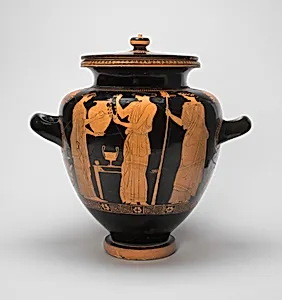
Stamnos (Mixing Jar)
about 450 BCE
Medium
terracotta, red-figure
Dimensions
37 × 26 cm (14 5/8 × 10 1/4 in.); Diam.: 26 cm (10 1/4 in.)
Classification
vessel
Department
Arts of Greece, Rome, and Byzantium
Museum
Art Institute of Chicago
Accession Number
177
Rights
Public Domain
About this artwork
This refined Athenian stamnos (pl. stamnoi) was used to mix water and wine. Also valued for its beauty, this red-figure vessel (so called because the figures remain the natural color of the clay) portrays either Greek women or maenads, female participants in rites celebrating Dionysos, the god of wine. But unlike the frenzied and whirling figures of other Greek vases, these women convey calm, even elegance. This tender serenity, coupled with a softer, somewhat freer form, is a hallmark of the ar...
Art Historical Context
This elegant stamnos, or mixing jar, was crafted around 450 BCE by the Chicago Painter, an accomplished Athenian vase painter whose name derives from a related work in the Art Institute’s collection. Created during the height of Athens’s Classical period, the vessel exemplifies the refined artistry of Greek pottery at a time when Athens dominated Mediterranean trade and cultural life. Its balanced proportions and graceful form highlight the technical mastery required to shape and fire terracotta into functional yet beautiful objects. The red-figure technique seen here represents a major artistic innovation of the late sixth century BCE. By painting the background black and leaving the figures in the natural red clay, artists could render anatomical details, drapery folds, and facial expressions with far greater subtlety than earlier black-figure methods allowed. On this stamnos, the technique would have showcased lively scenes from mythology or daily life, inviting viewers to appreciate both the narrative and the painter’s skill. In ancient Greece, a stamnos served an important social role, holding diluted wine for symposia—gatherings where citizens discussed philosophy, politics, and poetry. Today, this vessel offers visitors a tangible connection to those conversations and to the enduring legacy of Athenian artistic achievement.
About the Artist
Chicago Painter
**The Chicago Painter** was an anonymous ancient Greek vase painter active in Athens during the middle of the fifth century BCE. His true name remains unknown, as is typical for most Attic artisans of the period, but his distinctive hand was first recognized by the pioneering British scholar Sir John Beazley. In his 1918 publication *Attic Red-Figured Vases in American Museums*, Beazley identified...