
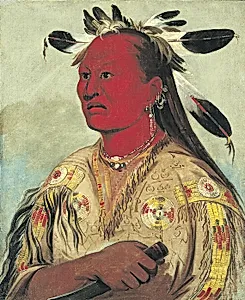
Stán-au-pat, Bloody Hand, Chief of the Tribe
1832
Medium
Painting
Classification
Painting
Department
Smithsonian Collection
Museum
Smithsonian American Art Museum
Credit
Smithsonian American Art Museum, Gift of Mrs. Joseph Harrison, Jr.
Accession Number
1985.66.123
Rights
Public Domain
Tags
About this artwork
George Catlin described Bloody Hand, chief of the Arikara tribe, as having “his face painted with red vermilion, scalping-knife in his hand,” and “wearing a beautiful dress.” Catlin was fortunate to meet Bloody Hand and his daughter when they were visiting the smaller of two Mandan towns. Since 1823, when traders from the American Fur Company allied with the Sioux to attack and destroy their village, the Arikara had harbored “hostile and deadly” feelings toward all whites. Catlin painted Stán-au...
Art Historical Context
**Stán-au-pat, Hand, Chief of the** (1832) by Georgelin captures the striking presence of an Arikara leader during Catlin's ambitious expedition to document Native American life in the early 19th century. This bust-length portrait depicts Bloody Hand with his face vividly painted in red vermilion, a scalping knife gripped in his hand, and in elaborate Indian dress. Catlin, a pioneering artist and ethnographer, painted over 600 such works to preserve vanishing tribal cultures amid rapid American expansion. The artwork's historical context is rich with tension. The Arikara, whose village had been destroyed in a 1823 attack by American Fur Company traders allied with the Sioux, harbored deep hostility toward whites. Catlin was remarkably fortunate to paint Bloody Hand and his daughter during a rare visit to a Mandan town, later completing the portrait at an Arikara village in 1832. This encounter underscores the risks Catlin faced in his quest. As part of the Smithsonian American Art Museum's collection, the painting exemplifies Catlin's realistic style—rooted in Romanticism yet documentary in intent—highlighting cultural symbols like ceremonial paint and weapons. It offers visitors a poignant window into Arikara pride and resilience on the Great Plains. (198 words)
About the Artist
George Catlin · 1796–1872
George Catlin (1796–1872), born in Wilkes-Barre, Pennsylvania, to Putnam Catlin and Polly Sutton—who had been captured by Native Americans during the 1778 Battle of Wyoming—initially pursued a legal career. Trained at Litchfield Law School, he was admitted to the bar in 1819 but abandoned law after two years to study art in Philadelphia in 1823. Self-taught as a portraitist, Catlin quickly gained ...