
Star-Shaped Tile
Unknown Artist
dated A.H. 663/ 1265 CE
Medium
Stonepaste; luster-painted with touches of cobalt on opaque white glaze under transparent glaze
Dimensions
H. 8 in. (20.3 cm) W. 8 in. (20.3 cm) Wt. (whole group): 51 lbs. (23.1 kg)
Classification
Ceramics-Tiles
Department
Islamic Art
Museum
Metropolitan Museum of Art, New York, NY
Credit
H.O. Havemeyer Collection, Gift of Horace Havemeyer, 1941
Accession Number
41.165.25
Rights
Public Domain
Tags
Art Historical Context
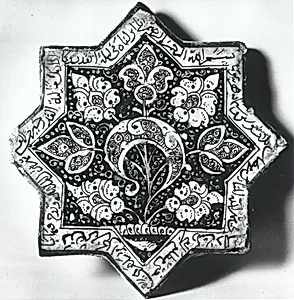
This exquisite star-shaped tile, dated A.H. 663 (1265 CE), hails from the Islamic world during a golden age of ceramic innovation. Crafted from stonepaste—a composite body mimicking porcelain's fineness—it exemplifies the technical mastery of medieval Islamic potters. The tile's surface shimmers with luster-painting, where metallic oxides create an iridescent glow over an opaque white glaze, accented by subtle cobalt touches under a transparent top layer. Measuring 8 inches square, it formed part of a larger architectural ensemble, as evidenced by the 51-pound weight of the group. Lusterware like this reached its zenith in 13th-century Syria and Iran, often adorning mosques, palaces, and madrasas. The star shape echoes Islamic geometric motifs symbolizing the cosmos and divine order, while tags suggest delicate floral designs intertwined with Arabic script—common in tiles that blended beauty with spiritual messaging. This technique, revived from Abbasid roots, dazzled with its jewel-like sheen, rivaling costly glass and metalwork. Now in the Metropolitan Museum of Art's Islamic Art Department, gifted from the H.O. Havemeyer Collection in 1941, the tile invites us to marvel at artisans' alchemy: turning clay into starlit splendor that lit up medieval skies.