
Hexagonal Tile
Unknown Artist
15th–16th century
Medium
Composite body; glazed
Dimensions
H. 6 3/4 in. (17.1 cm) W. 6 3/4 in. (17.1 cm)
Classification
Ceramics-Tiles
Department
Islamic Art
Museum
Metropolitan Museum of Art, New York, NY
Credit
Museum Accession
Accession Number
x.228.2
Rights
Public Domain
Tags
Art Historical Context
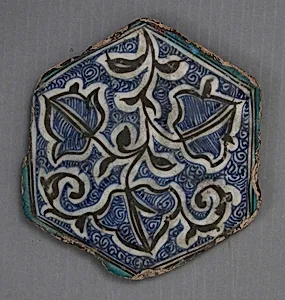
This hexagonal tile presents a lively surface of stylized leaves and curving stems rendered in deep cobalt blue, white, and black against a lighter ground. The design radiates from the center in a balanced arrangement of heart-shaped foliage and delicate tendrils, all enclosed by a narrow border of smaller scrolling motifs. Glaze covers the composite body, lending a subtle sheen that highlights the crisp lines of the painted decoration, while the edges show the natural wear of age and use. Created by an unknown artist in the 15th or 16th century, the tile belongs to the long tradition of Islamic ceramic work, where such pieces were often assembled into larger patterns on walls, floors, or domes. Its compact size and geometric shape suggest it formed part of an architectural scheme, contributing both color and rhythm to an interior space. Today in the collection of The Metropolitan Museum of Art, it offers visitors a direct glimpse of the skill and visual harmony valued in that period.