
Stoke-by-Neyland
Medium
Mezzotint touched with white chalk and black ink; proof before published state
Dimensions
Image: 5 5/8 × 8 5/8 in. (14.3 × 21.9 cm) Plate: 7 × 9 7/8 in. (17.8 × 25.1 cm) Sheet: 8 5/8 × 12 3/4 in. (21.9 × 32.4 cm)
Classification
Prints
Department
Drawings and Prints
Museum
Metropolitan Museum of Art, New York, NY
Credit
Harris Brisbane Dick Fund, 1927
Accession Number
27.4.18
Rights
Public Domain
Tags
Art Historical Context
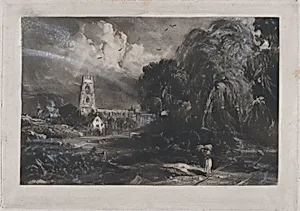
**Stoke-by-Neyland (1829)** is a captivating proof print from the collaboration between landscape master John Constable and engraver David Lucas. Created as part of Constable's ambitious *English Landscapes* series, it depicts the quaint Suffolk village of Stoke-by-Neyland, a region close to Constable's heart in East Anglia. This proof, before the final published state, captures the artist's vision of rural England during the early 19th century, a time when industrialization threatened such idyllic scenes. Constable, a Romantic pioneer, championed the unvarnished beauty of his native countryside, influencing generations of artists. The medium—mezzotint touched with white chalk and black ink—highlights innovative printmaking techniques. Mezzotint, known for its velvety blacks and subtle tonal gradations, allowed Lucas to translate Constable's loose, atmospheric sketches into rich, painterly reproductions. These hand-applied touches reveal the iterative creative process, offering visitors a rare glimpse into the artists' workshop. Measuring just 5⅝ × 8⅝ inches, its intimate scale invites close inspection of intricate village details like thatched roofs and winding paths. Housed in the Metropolitan Museum of Art's Drawings and Prints department (Harris Brisbane Dick Fund, 1927), this work underscores the cultural value of preserving England's pastoral heritage through print. It's a testament to Constable's belief that mezzotint could rival oil painting in evoking nature's luminosity and mood.
About the Artist
David Lucas|John Constable · 1802–1881
**David Lucas (1802–1881)** David Lucas was born in 1802 in Geddington Chase, Northamptonshire, the son of a farmer.) A chance encounter in 1820 led him to become a pupil of the renowned engraver Samuel William Reynolds, under whom he apprenticed in London until 1827, mastering the art of mezzotint engraving.) By 1827, Lucas had published his first mezzotints, showcasing his precocious talent for...