
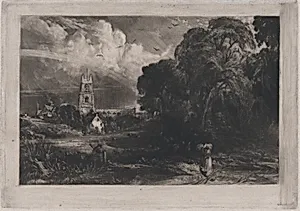
Stoke-by-Neyland
Medium
Mezzotint; proof before published state
Dimensions
Image: 5 5/8 × 8 11/16 in. (14.3 × 22.1 cm) Plate: 7 × 9 15/16 in. (17.8 × 25.2 cm) Sheet: 8 × 11 in. (20.3 × 27.9 cm)
Classification
Prints
Department
Drawings and Prints
Museum
Metropolitan Museum of Art, New York, NY
Credit
Harris Brisbane Dick Fund, 1927
Accession Number
27.4.20
Rights
Public Domain
Tags
Art Historical Context
"Stoke-by-Neyland," a captivating 1829 mezzotint created by engraver David Lucas after John Constable's design, offers visitors a serene glimpse into the Suffolk countryside that Constable cherished. This rural village scene, rich with lush trees and quaint architecture, captures the artist's deep affection for his native East Anglia. As an early proof before the published state, it preserves the raw evolution of the image, showcasing subtle adjustments in tone and detail that would refine the final print. Mezzotint, a technique pioneered in the 17th century, revolutionized printmaking by allowing artists to achieve painterly effects through a textured copper plate rocked to create a velvety black ground, then scraped and burnished for luminous highlights. Lucas's masterful collaboration with Constable—part of the ambitious "English Landscape Scenery" series—brought the painter's oil sketches to a wider audience, democratizing Romantic landscapes during the early 19th century. Constable's loose, atmospheric style, evoking nature's fleeting light and mood, translates beautifully into this intimate format (image: 5 5/8 × 8 11/16 in.). Housed in The Metropolitan Museum of Art's Drawings and Prints department, this work highlights printmaking's role in preserving ephemeral sketches. For Constable enthusiasts, it's a testament to how innovative techniques bridged painting and reproduction, making his beloved vistas enduringly accessible.
About the Artist
David Lucas|John Constable · 1802–1881
**David Lucas (1802–1881)** David Lucas was born in 1802 in Geddington Chase, Northamptonshire, the son of a farmer.) A chance encounter in 1820 led him to become a pupil of the renowned engraver Samuel William Reynolds, under whom he apprenticed in London until 1827, mastering the art of mezzotint engraving.) By 1827, Lucas had published his first mezzotints, showcasing his precocious talent for...