
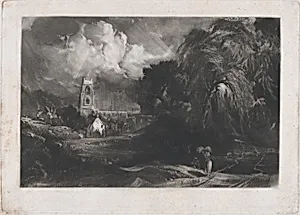
Stoke-by-Neyland
Medium
Mezzotint; proof before published state
Dimensions
Image: 5 5/8 × 8 9/16 in. (14.3 × 21.7 cm) Plate: 7 × 9 7/8 in. (17.8 × 25.1 cm) Sheet: 11 5/8 × 15 1/2 in. (29.5 × 39.4 cm)
Classification
Prints
Department
Drawings and Prints
Museum
Metropolitan Museum of Art, New York, NY
Credit
Harris Brisbane Dick Fund, 1939
Accession Number
39.68.12
Rights
Public Domain
Tags
Art Historical Context
Created in 1829, *Stoke-by-Nayland* is a mezzotint print engraver David Lucas after a landscape painting by John Constable. The image captures a tranquil English village scene, with clustered cottages nestled among trees under a sweeping sky—a quintessential view of rural Suffolk that Constable knew intimately. As a proof before the published state, this impression offers a rare glimpse into the collaborative process between painter and printmaker, revealing subtle tonal adjustments made before the final edition. Constable, a leading figure of the Romantic movement, sought to convey the freshness and emotional power of nature through his landscapes. Working with Lucas, he embraced mezzotint for its remarkable ability to render rich, velvety blacks and delicate gradations of light, qualities that beautifully translated the atmospheric effects of his oil paintings into print form. This technique allowed broader audiences to experience Constable’s vision of the countryside during an era of rapid industrialization. Housed in the Metropolitan Museum of Art’s collection of drawings and prints, the work highlights the 19th-century interest in reproductive prints as a means of sharing art beyond the gallery walls. Its modest scale and intricate tonal range invite quiet contemplation of England’s pastoral heritage.
About the Artist
David Lucas|John Constable · 1802–1881
**David Lucas (1802–1881)** David Lucas was born in 1802 in Geddington Chase, Northamptonshire, the son of a farmer.) A chance encounter in 1820 led him to become a pupil of the renowned engraver Samuel William Reynolds, under whom he apprenticed in London until 1827, mastering the art of mezzotint engraving.) By 1827, Lucas had published his first mezzotints, showcasing his precocious talent for...