
Study for a Composition
1940–41
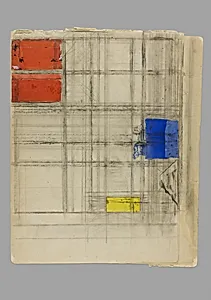
Medium
Collage of cut and pasted papers, prepared with gouache and charcoal, on pieced cream wove newsprint in three parts with charcoal on verso
Dimensions
Max: 33 × 27 cm (13 × 10 11/16 in.)
Classification
collage
Department
Prints and Drawings
Museum
Art Institute of Chicago
Accession Number
142570
Rights
Public Domain
About this artwork
In 1916, after a long search for an entirely new visual vocabulary to represent the physical world, Piet Mondrian arrived at a fully abstract style. He reduced bridges, churches, rivers, trees, and more to a series of horizontal and vertical black lines enclosing fields of unmixed red, blue, and yellow as well as white, black, and gray. This artistic idiom, eventually called Neoplasticism, removed naturalism from painting to reveal the essence of visual forms and provide viewers with a transcend...
Art Historical Context
Piet Mondrian, a leading figure of the De Stijl movement and a pioneer of geometric abstraction, created this collage during his early years in New York after fleeing wartime Europe. Dating from 1940–41, *Study for a Composition* reflects the artist’s lifelong pursuit of harmony through simplified forms, horizontal and vertical lines, and balanced color relationships. As a preparatory work, it offers a rare glimpse into Mondrian’s meticulous process of refining his iconic neoplastic style before committing ideas to canvas. The piece is constructed from cut and pasted papers prepared with gouache and charcoal, assembled on pieced newsprint. This choice of humble, everyday materials underscores Mondrian’s interest in exploring composition through layering and rearrangement. The tactile quality of the collage allows viewers to see how he tested spatial relationships and tonal contrasts, with charcoal marks on the verso hinting at further experimentation. Now housed in the Art Institute of Chicago’s Prints and Drawings collection, the work highlights Mondrian’s innovative use of collage as both a practical tool and an artistic statement. Its modest scale—measuring just 33 by 27 centimeters—belies the profound influence these studies had on the development of modern abstract art.
About the Artist
Piet Mondrian · 1872–1944
**Piet Mondrian** (born Pieter Cornelis Mondriaan, 7 March 1872 – 1 February 1944) was a Dutch painter and theoretician who became one of the most influential figures in 20th-century abstract art. Born in Amersfoort, Netherlands, as the second of his parents’ children, he grew up in a creative household; his father was a qualified drawing teacher and headmaster, while his uncle, Frits Mondriaan, a...