
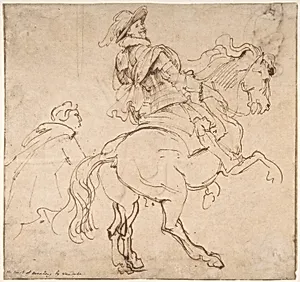
Study for an Equestrian Portrait, Possibly that of Albert de Ligne, Count of Arenberg; verso: Various Studies of Statues and Figures, Including the Venus Pudica and Scipio and his Lictor
ca. 1628–32
Medium
Pen and brown ink; verso: pen and brown ink, black chalk
Dimensions
9 1/16 x 9 5/8 in. (23 x 24.5 cm)
Classification
Drawings
Department
Drawings and Prints
Museum
Metropolitan Museum of Art, New York, NY
Credit
Gift of Harold K. Hochschild, 1940
Accession Number
40.91.16
Rights
Public Domain
Tags
Art Historical Context
Anthony van Dyck, the eminent Flemish Baroque master renowned for his elegant portraits of nobility, created this dynamic drawing around 1628–32, during his prolific period after returning from Italy to Antwerp. Titled *Study for an Equestrian Portrait, Possibly that of Albert de Ligne, Count of Arenberg*, the recto captures a rider and horse in fluid motion, likely preparatory for a grand painting celebrating aristocratic power. Equestrian portraits, a hallmark of 17th-century European art, symbolized status and heroism, echoing classical ideals van Dyck admired. Executed in pen and brown ink on both sides, the sheet measures a modest 9 1/16 x 9 5/8 inches, showcasing van Dyck's virtuoso draftsmanship. The verso reveals eclectic studies of antique statues, including the graceful *Venus Pudica*—a classical motif of modest femininity—and *Scipio and his Lictor*, drawing from Roman history to infuse modern figures with timeless gravitas. Black chalk adds depth on the reverse, highlighting van Dyck's blend of line and tone for lifelike energy. Now in the Metropolitan Museum of Art's Drawings and Prints department (gift of Harold K. Hochschild, 1940), this double-sided gem offers a rare glimpse into the artist's process, bridging classical antiquity with Baroque vitality. Visitors will appreciate how such studies fueled van Dyck's masterpieces, like those for European courts.
About the Artist
Anthony van Dyck · 1599–1641
Sir Anthony van Dyck (1599-1641) was a Flemish Baroque artist who revolutionized portrait painting and became the most influential court painter in 17th-century England. Born in Antwerp as the seventh of twelve children to a prosperous silk merchant, van Dyck displayed extraordinary artistic talent from childhood. He trained under Hendrick van Balen before joining Peter Paul Rubens's workshop as a...