
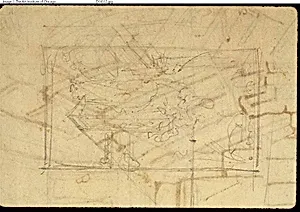
Study for Exhibition Room, Somerset House, from Microcosm of London (recto); Sketch of a Painting: Madonna and Child (verso)
1807 (recto); c. 1807 (verso)
Medium
Pen and brown ink over graphite (recto), and graphite on paper (verso), on ivory wove paper
Dimensions
23.3 × 36.7 cm (9 3/16 × 14 1/2 in.)
Classification
pen and ink drawings
Department
Prints and Drawings
Museum
Art Institute of Chicago
Accession Number
113149
Rights
Public Domain
Art Historical Context
This double-sided drawing by Augustus Charles Pugin, prolific British draughtsman andaver, captures the artist's meticulous eye for architecture and versatility in subject matter. Created around 1807, the recto features a detailed study for the Exhibition Room at Somerset House, for *Microcosm of London*a celebrated three-volume publication (1808–1810) that vividly depicted London's landmarks and interiors through Pugin's precise illustrations alongside Thomas Rowlandson's figures. Somerset House, then the Royal Academy's exhibition venue, symbolized the vibrant cultural heart of Regency London, where artists showcased their works to elite audiences. Executed in pen and brown ink over graphite on ivory wove paper, the recto demonstrates Pugin's mastery of fine lines and subtle shading to convey spatial depth and ornate neoclassical details like columns and galleries. Flipping to the verso reveals a softer graphite sketch of a *Madonna and Child*, hinting at Pugin's broader interests beyond topography, possibly inspired by Renaissance traditions. At 23.3 × 36.7 cm, this preparatory work highlights the collaborative, innovative printmaking of the era, bridging art and documentation for a growing public fascination with urban life. Housed in the Art Institute of Chicago's Prints and Drawings department, it offers a glimpse into early 19th-century artistic processes.
About the Artist
Augustus Charles Pugin · 1762–1832
Augustus Charles Pugin (1762–1832) was a pioneering architectural draughtsman and engraver whose meticulous illustrations played a pivotal role in reviving interest in Britain's medieval Gothic heritage. Born in France, Pugin relocated to London around 1792, where he quickly established himself as a master of topographical and architectural rendering. Working primarily in engraving and watercolor,...