
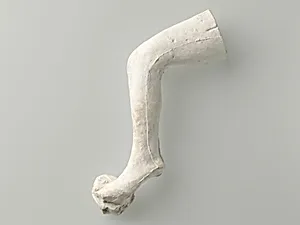
Study of a leg
last quarter 19th–early 20th century
Medium
Cast plaster
Dimensions
Length: 4 1/2 in. (11.4 cm)
Classification
Sculpture
Culture
French
Department
European Sculpture and Decorative Arts
Museum
Metropolitan Museum of Art, New York, NY
Credit
Gift of Auguste Rodin, 1912
Accession Number
12.12.13
Rights
Public Domain
Tags
Art Historical Context
Auguste Rodin's *Study of a Leg*, in the last quarter of the 19th to early 20th century exemplifies the French sculptor's revolutionary approach to the human form. This intimate cast-plaster piece, just 4½ inches long, captures the muscular tension and subtle curves of a single leg in dynamic isolation. Rodin, a pioneer of modern sculpture, rejected the smooth idealism of neoclassicism in favor of raw, expressive surfaces that reveal the artist's hand—evident here in the textured plaster finish. As a preparatory study, this work reflects Rodin's meticulous process for masterpieces like *The Gates of Hell* and *The Thinker*. He produced hundreds of such anatomical fragments from life models, assembling and reassembling them to build complex compositions. Cast plaster allowed for quick iterations and multiples, bridging the gap between sketch and final bronze. Gifted directly by Rodin to the Metropolitan Museum of Art in 1912, it offers a rare glimpse into his studio practice. Housed in the Met's European Sculpture and Decorative Arts department, this modest fragment underscores Rodin's enduring influence: by focusing on the body's vitality, he elevated the study itself to art, inspiring generations of sculptors to embrace imperfection and movement.
About the Artist
Auguste Rodin · 1840–1917
François Auguste René Rodin (1840-1917) stands as the founder of modern sculpture, transforming the art form from academic tradition into expressive modernism. Born into a working-class Parisian family, Rodin faced early rejection, failing three times to gain admission to the prestigious École des Beaux-Arts. This setback forced him to work as a craftsman for nearly two decades, though his 1875 tr...